📚 Article contents:
- What is an employment contract and why is it important?
- Mandatory elements of an employment contract?
- Rights and obligations of employees and employers?
- Difference between fixed-term and permanent contracts?
- Ways of terminating employment?
- Most common mistakes in practice and how to avoid them?
- FAQ – frequently asked questions about employment contracts?
- Conclusion: how to protect yourself and act responsibly?
1. What is an employment contract and why is it important?
An employment contract is the legal basis for establishing an employment relationship between the employer and the employee, defining the obligations, rights and conditions under which the work is performed, and it is a key document that protects both parties.
Under the Labor Law of the Republic of Serbia (Zakon o radu), employment is established exclusively on the basis of an employment contract concluded in writing and by the employee starting work on the date set out in the contract.
*Even without a signed contract, a worker is still considered employed if they started working with the employer’s knowledge and approval – something both parties in this relationship often forget.
2. What must an employment contract contain?
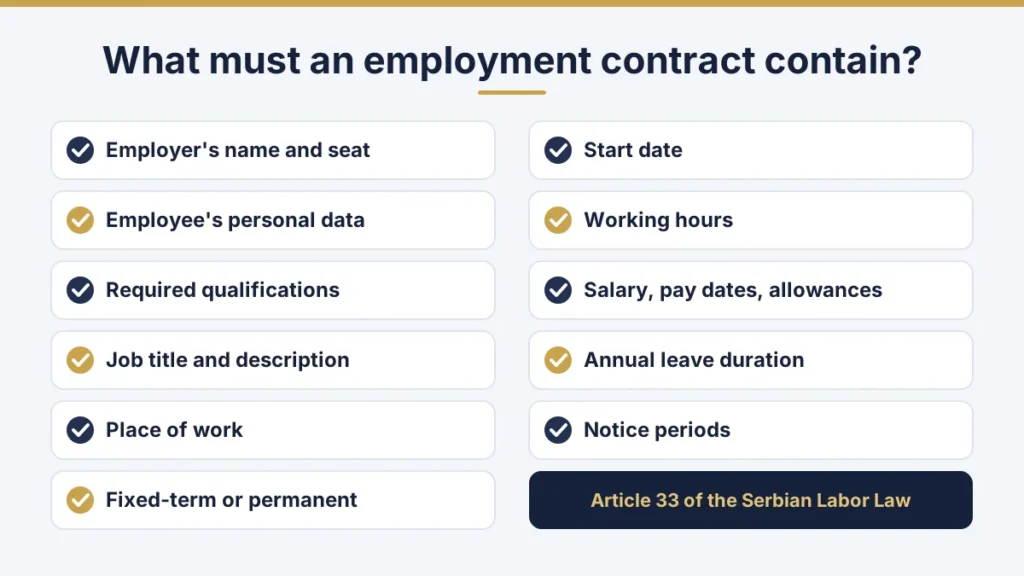
Under Article 33 of the Labor Law, every employment contract must contain the following key elements:
- the employer’s name and registered seat,
- the employee’s personal data,
- the type and level of qualifications required for the job
- the job title and description of the work the employee is to perform,
- place of work,
- type of employment (fixed-term or permanent)
- start date,
- working hours,
- salary, payment deadlines and allowances,
- duration of annual leave,
- notice periods.
Tips for employers: Do not use generic, one-size-fits-all contracts without adapting them to the specific working conditions. This can often lead to the contract being invalid or terminated unilaterally.
3. Rights and obligations – what do you need to know?
For employees:
- The right to a salary and allowances (meal allowance, transport, holiday bonus…)
- The right to safe working conditions
- The right to annual leave, sick leave, pregnancy and maternity leave
- The right not to be dismissed without a justified reason
For employers:
- The right to organize the work process and set goals
- The obligation to pay salaries regularly
- The obligation to comply with occupational health and safety regulations
- The possibility to terminate the contract in accordance with the law
*Practical example: If an employee fails to come to work without justification for 3 days in a row, the employer has grounds to terminate the employment contract – but only if this is provided for in the employment contract or the work regulations, and a prior warning has been documented.
4. Fixed-term or permanent contract – which to choose?
A fixed-term contract is permitted for a maximum of 24 months and may be concluded only if there are certain objective reasons why the employment lasts for a limited time, except in specific situations when it may last longer than 24 months (e.g. replacing a temporarily absent employee, work on a project, etc.).
A permanent contract is the rule, while a fixed-term contract is the exception. It provides greater security to the employee, but also obliges the employer, if it terminates the contract, to follow a precisely defined procedure and meet the statutory conditions for dismissal (e.g. payment of severance pay, outstanding wages, compensation for unused annual leave, etc.).
*Important: Employers often try to extend fixed-term contracts through “new contracts” – this may be unlawful and may be considered an attempt to circumvent the employee’s rights, which may result in the employee filing a lawsuit.
5. How does an employment contract end?
A contract may end:
- By agreement of the parties
- By resignation of the employee (with a notice period)
- By dismissal by the employer (with a statement of reasons and a legal basis)
- By expiry of the term (for fixed-term contracts)
- By retirement, death of the employee, dissolution of the employer, etc.
Most important: The employer must have a justified reason and document the dismissal process for it to be lawful.
6. Most common mistakes in practice
- No written contract concluded
- Vaguely defined job description
- Non-payment of taxes and contributions and undeclared “off the books” work
- Extending fixed-term contracts beyond the statutory limits
- Dismissal without prior warning
*Solution: Every employer should have a lawyer or legal advisor who checks that contracts comply with the law and the company’s needs. And every employee should read every clause before signing – or ask a lawyer.
7. FAQ – Frequently asked questions
1. Can an employment contract be concluded verbally?
No. The law expressly requires a written form in three copies. However, if you start working and the contract has not been signed, the employment is deemed to have been established for an indefinite period.
2. Is a probationary period mandatory?
No. A probationary period is optional and must be specifically agreed in the contract, for a maximum of 6 months.
3. Can I have several employment contracts with several employers?
Yes, but both contracts must be part-time, totalling 40 hours per week, with the consent of both employers. In that case, the employee is entitled to the rights under the Labor Law in proportion to the time spent with each employer.
4. Can the contract be changed unilaterally?
No. Amending the contract requires the consent of both parties and the signing of an annex to the contract.
8. Conclusion – a contract that is not just a formality
An employment contract is not an ordinary piece of paper – it is the foundation of your professional life or business. If drafted properly, it protects both parties and reduces the risk of conflict. If neglected, it becomes a source of potential problems, lawsuits and dissatisfaction.
For employees: Read the contract carefully. Ask about anything that is not clear to you.
For employers: Do not copy contracts from the internet. Invest in legal advice – it is much cheaper than a court dispute.
Note: This blog is for informational purposes only and does not constitute legal advice. For specific questions and legal support, please contact the Dvornić law office.