Contents
- When must wages be paid?
- What if the employer does not pay the salary?
- What is a statement, i.e. a calculation of unpaid wages?
- Which contributions does the employer pay for the employee?
- How much does the employer pay in contributions on the minimum wage?
- What if the employer does not pay contributions?
- What if the employer pays the salary first and the contributions later?
- How to check whether the employer pays contributions?
- What if the employer does not pay contributions during pregnancy?
- How to recover unpaid wages?
- How to sue the employer for unpaid salaries?
- Interest on unpaid wages
- Unpaid wages after dismissal
- How to collect unpaid wages in bankruptcy proceedings?
- FAQ – frequently asked questions
- Conclusion
You go to work regularly and do your job, but your salary is late. The employer promises that it will be paid “next week”, and then an even more serious question arises – were contributions paid for that period at all?
Unpaid wages and unpaid contributions are not only the employee’s problem. For the employer, they can represent a serious labor, tax and financial risk.
That is why it is important to distinguish three things: the net amount the employee receives, the tax and contributions calculated from the salary, and the contributions borne by the employer.
Below we explain what an employee can do when their salary has not been paid, how to check contributions and how the claims can be collected.
1. When must the employer pay wages?
Wages are paid within the deadlines set by the employment contract and the employer’s internal acts, at least once a month.
Under the Labor Law, wages for the previous month must be paid no later than the end of the current month.
This means that non-payment of wages is not just the employer’s business problem or a question of its current liquidity. The employee has a statutory right to be paid for the work performed.
2. What if the employer does not pay the salary?
If the employer does not have the funds to pay the employee’s wages, its obligation does not disappear.
It is particularly important that the employer is obliged to provide the employee with a payslip (wage calculation) even for the month for which wages were not paid, together with a notice that payment was not made and the reasons for non-payment.
The calculation of unpaid wages is not an insignificant piece of paper.
It may constitute an enforceable document, which in certain situations allows the employee to seek collection through enforcement proceedings, without first litigating for years to prove the obligation itself.
That is why an employee whose salary has not been paid should keep all the payslips received from the employer.
3. What is a statement, i.e. a calculation of unpaid wages?
In accordance with Article 121 of the Labor Law, the employer is obliged to provide the employee with a wage calculation showing how the amount due to the employee was determined.
Among other things, it shows data on wages, tax and contributions.
If wages have not been paid, the employer is still obliged to provide the employee with the corresponding calculation and a notice explaining why wages were not paid, no later than the end of the month for the previous month.
In practice, it often happens that the employer does not pay the salary and does not provide the calculation either.
This can further weaken the employee’s position, but it does not mean that their claim is lost.
The employer may be held liable for a misdemeanor and fined between RSD 800,000 and RSD 2,000,000 in accordance with Article 273 of the Labor Law.
4. Which contributions does the employer pay for the employee?
For employees in Serbia, contributions are paid for:
- pension and disability insurance;
- health insurance;
- unemployment insurance.
When speaking of contributions borne by the employer, it is important to distinguish them from the contributions calculated from the employee’s salary.
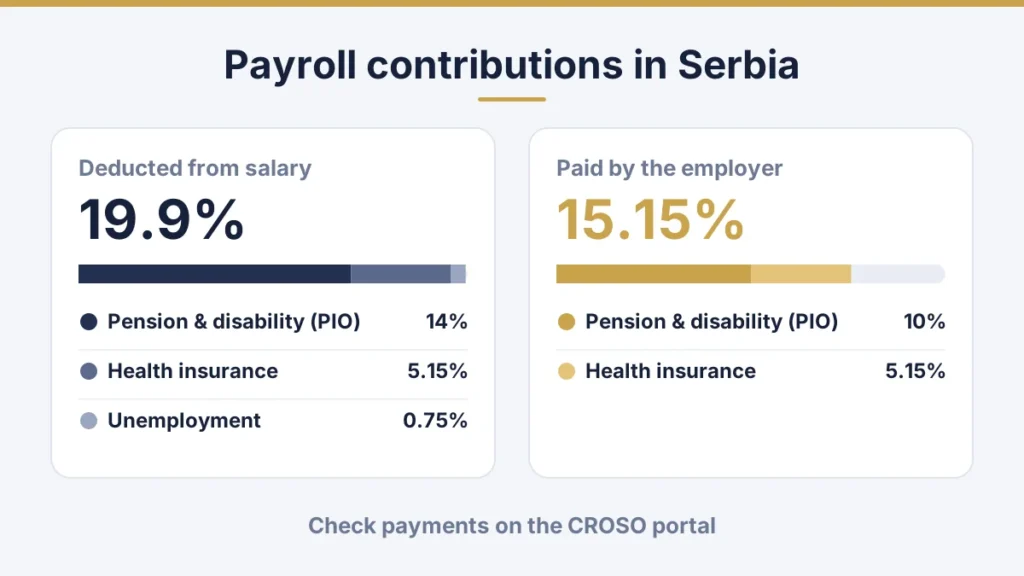
According to the applicable rates, the following are calculated from the employee’s salary:
- PIO (pension and disability insurance) – 14%;
- health insurance – 5.15%;
- unemployment – 0.75%.
The following are borne by the employer:
- PIO (pension and disability insurance) – 10%;
- health insurance – 5.15%.
This means that for a standard salary, a total of 15.15% in contributions on the applicable base is charged to the employer.
5. How much does the employer pay in contributions on the minimum wage?
This question does not have one fixed answer for every month.
The amount depends on:
- the amount of the salary;
- the number of working hours in the specific month;
- the lowest monthly contribution base;
- any tax relief;
- the employee’s status and other circumstances.
This is why the expression “contributions on the minimum wage” should not be reduced to one universal monetary amount.
It is important for the employer that the calculation is made correctly according to the applicable tax and contribution rules for the specific calculation period.
6. What if the employer does not pay contributions?
The employer is responsible for calculating and paying contributions for the employee.
The rule is that contributions are calculated and paid at the same time as wages are paid.
However, an important thing employees often do not know is that the contribution obligation does not disappear even when the employer does not pay the salary at all.
If wages for the previous month have not been paid by the last day of the current month, the employer is obliged to calculate and pay contributions by that deadline, at least on the prescribed lowest monthly base.
When it later pays the wages, it is obliged to pay any difference in contributions as well.
This is why a situation in which the employer says: “I didn’t pay the salary, so I had no obligation to pay contributions either” is not legally correct.
7. What if the employer pays the salary first and the contributions later?
As a rule, the employer calculates and pays contributions at the same time as it pays wages.
Paying the net amount to the employee while leaving taxes and contributions for some later time may constitute improper conduct by the employer.
It is therefore useful for the employee not only to check whether the money has arrived in their account, but also to check the status of their contributions from time to time.
8. How to check whether the employer pays contributions?
The employee can view data on their calculated and paid contributions through the portal of the Central Register of Compulsory Social Insurance – CROSO.
The portal allows an individual to view their data on compulsory social insurance contributions.
If the employee notices a discrepancy between the calculated and paid contributions, the problem should not be ignored, especially if it lasts for a longer period.
9. What if the employer does not pay contributions during pregnancy?
Pregnancy in itself does not release the employer from its obligations regarding the calculation and payment of contributions.
However, for sick leave due to complications related to maintaining a pregnancy and for later rights related to maternity leave, special rules may apply to salary compensation, calculation and reimbursement of funds.
A distinction should therefore be made between:
- the employee’s right to salary compensation;
- the obligation to calculate taxes and contributions;
- the question of who ultimately bears the cost of a particular compensation.
If contribution data have not been properly recorded, it is advisable to check the documentation and reported data as soon as possible.
10. How to recover unpaid wages?
An employee who has not received their salary can take several steps.
First, it is useful to obtain:
- the employment contract;
- contract annexes;
- payslips;
- bank account statements;
- work records;
- communication with the employer about unpaid wages.
A written request for payment of wages and related obligations can then be sent to the employer.
If payment is not made, depending on the documentation, enforcement or court proceedings may be considered.
It is also possible to contact the Labor Inspectorate within the scope of its competence.
11. How to sue the employer for unpaid salaries?
If the employee is unable to collect directly on the basis of an enforceable document, or if there are disputed issues regarding the amount of the claim, proceedings may be initiated before the competent court.
This also applies to employees in the private sector.
In the proceedings, unpaid wages and other related claims may be sought, together with interest.
It is particularly important to take into account the statute of limitations for monetary claims arising from employment, which is why the employee should not postpone taking action for years.
12. Interest on unpaid wages
When the employer is late with payment, in addition to the principal debt, the employee may also be entitled to statutory default interest.
Interest is calculated from the due date of each individual claim until it is paid.
If, for example, an employee has not been paid six consecutive salaries, each monthly salary is a separate claim that has fallen due, and interest is calculated in relation to the due date of each individual amount.
Over a longer period of non-payment, interest can become a significant part of the total claim.
13. Unpaid wages after dismissal
Termination of employment does not erase the employer’s debt.
If the employee’s employment ends, the employer must still settle unpaid wages, compensation and other due earnings from employment.
Therefore, the employee does not lose the right to past wages simply because they:
- resigned;
- signed a mutual termination agreement;
- were dismissed;
- finished a fixed-term employment with the employer.
In the case of mutual termination, any statements regarding mutual claims should be read especially carefully.
14. How to collect unpaid wages in bankruptcy proceedings?
The situation becomes more complex when bankruptcy proceedings have been opened against the employer.
The claim is then no longer collected in the same way as against an employer that is still operating.
The employee must take care of:
- filing the claim in the bankruptcy proceedings;
- deadlines;
- evidence of the amount of the debt;
- the status of the claim;
- special rights of employees in bankruptcy.
The Labor Law also provides for special rights of employees of an employer against which bankruptcy proceedings have been opened, including a system of protection through the Solidarity Fund for certain claims and under conditions prescribed by law.
Because of the short procedural deadlines in bankruptcy, it is particularly important to react as soon as the employee learns that the proceedings have been opened.
15. FAQ – frequently asked questions
Does the employer have to give me a payslip if it has not paid my salary?
Yes. The employer is obliged to provide the calculation even for the month in which wages were not paid, together with a notice of the reason for non-payment.
Is the calculation of unpaid wages an enforceable document?
The calculation of wages that the employer is obliged to pay under the Labor Law has the status of an enforceable document.
What if the employer does not pay contributions?
The employee can check the data through the CROSO portal, and irregularities may be subject to inspection by the competent authorities. Depending on the specific problem, legal steps can also be taken to protect the employee’s rights.
Does the employer have to pay contributions if it has not paid wages?
Yes. If wages for the previous month have not been paid by the last day of the current month, there is an obligation to calculate and pay contributions at least on the lowest monthly base.
Which contributions does the employer pay?
In a standard employment relationship, contributions cover pension and disability insurance (PIO), health insurance and unemployment insurance, with part of the contributions borne by the employee and part by the employer.
Can I claim interest on an unpaid salary?
Yes. Statutory default interest can be claimed on wages that have fallen due but have not been paid.
Do I lose the right to unpaid salaries if I am dismissed?
No. Termination of employment does not erase the employee’s monetary claims that have already arisen.
16. Conclusion
Unpaid wages are not just a “late salary”, and contributions are not a secondary accounting obligation of the employer. These are employee rights that directly affect their income, pension and health insurance and other rights within the social insurance system.
It is therefore important for the employee not only to monitor whether wages have been paid into their bank account, but also to keep payslips and check the status of their contributions from time to time.
For the employer, correct and timely payment of wages, calculation of taxes and contributions and proper record-keeping are among the basic elements of lawful business operations.
If wages have not been paid, the problem should not be left unresolved for months or years. The sooner the amount of the debt, the documentation and the status of contributions are established, the easier it is to assess which method of collection and protection of rights makes the most sense.
Note: This article is for informational purposes only and does not constitute legal or tax advice for a specific case.
For specific questions and legal support, please contact the Dvornić law office.