Contents
- What is overtime?
- How long can overtime last?
- Overtime: pay rate and compensation
- Overtime calculation: an example
- Is work on Saturday or Sunday automatically overtime?
- How to prove unpaid overtime?
- Is a written overtime order required?
- Daily overtime records
- Overtime and redistribution of working hours
- Overtime and days off
- Special rules for the Ministry of Interior (MUP), healthcare and education
- Overtime on a business trip
- Overtime lawsuit
- Deadline for filing a lawsuit
- FAQ – frequently asked questions
- Conclusion
You stay at work an extra hour every day. You work on Saturdays when a project deadline is approaching. You answer your employer’s requests after regular working hours, yet the same amount appears on your payslip every month.
Is that overtime, and can you demand to be paid for it?
On the other hand, employers often face the opposite problem: an employee later claims to have worked overtime for months, even though there was no order and no proper record of the time spent at work.
That is exactly why it is important to know when overtime exists, how its rate is calculated and, especially important in a court dispute, how overtime is proven .
1. What is overtime?
Article 53 of the Labor Law defines overtime as work that an employee, at the employer’s request, performs beyond their full working hours in situations provided for by law.
It should not be a regular way of organizing work.
Overtime may be required, among other things, in the event of force majeure, a sudden increase in workload or when it is necessary to complete unplanned work within a certain deadline.
This is why a situation in which an employee works ten hours every day for years, although their contract provides for full-time work of eight hours a day, may indicate a problem in how working hours are organized.
2. How long can overtime last?
Overtime is not unlimited.
Under the general employment regime, an employee may work overtime for a maximum of eight hours per week, and the employee’s total working time, including overtime, may not exceed 12 hours per day.
These limits matter to both employees and companies.
The fact that an employee is willing to work longer, or that there is a large workload, does not mean that the statutory limits on working hours can be ignored.
3. Overtime – pay rate and compensation
One of the most common internet searches is: “overtime pay rate”.
For overtime, the employee is entitled to increased pay of at least 26% of the base.
In practice, this means the employee is not paid only an extra 26% for the hour worked. They receive the pay for the hour worked plus an increase of at least 26%.
A more favorable percentage may also be provided for in the employment contract , the employer’s work regulations or a collective agreement.
If an employee is simultaneously entitled to increases on several grounds, for example working overtime during the night or on a public holiday that is a non-working day, all the increases they are entitled to should be checked.
4. Overtime calculation – an example
Suppose that the value of the employee’s basic working hour is RSD 1,000.
During the month, the employee works 20 hours of overtime.
The base value of those hours is:
20 × 1,000 = RSD 20,000
The minimum increase of 26% is:
20,000 × 26% = RSD 5,200
For those 20 overtime hours, the employee would, in simplified terms, earn a total of RSD 25,200, assuming there are no additional grounds for an increase.
For a specific calculation, it is necessary to check the payslips, the basic salary, the number of hours actually worked and the employer’s internal regulations.
5. Is work on Saturday or Sunday automatically overtime?
No.
This is one of the most common misconceptions.
Working on Saturday is not automatically overtime. The same applies to working on Sunday.
If the employee’s work schedule is organized so that Saturday is a regular working day, the mere fact that they worked on Saturday does not mean they are entitled to the overtime increase.
On the other hand, if the employee works full time from Monday to Friday and then, on the employer’s order, comes in to work another eight hours on Saturday, such work may constitute overtime.
This is why a dispute does not only look at which day the employee worked, but at how many hours they worked according to the established schedule and why the additional work was introduced.
6. How to prove unpaid overtime?
This is the central question in every overtime lawsuit.
The ideal situation is when the employer keeps proper daily records and issues written orders for additional work.
In practice, however, disputes most often arise precisely when such documentation does not exist or when the records do not reflect the actual situation.
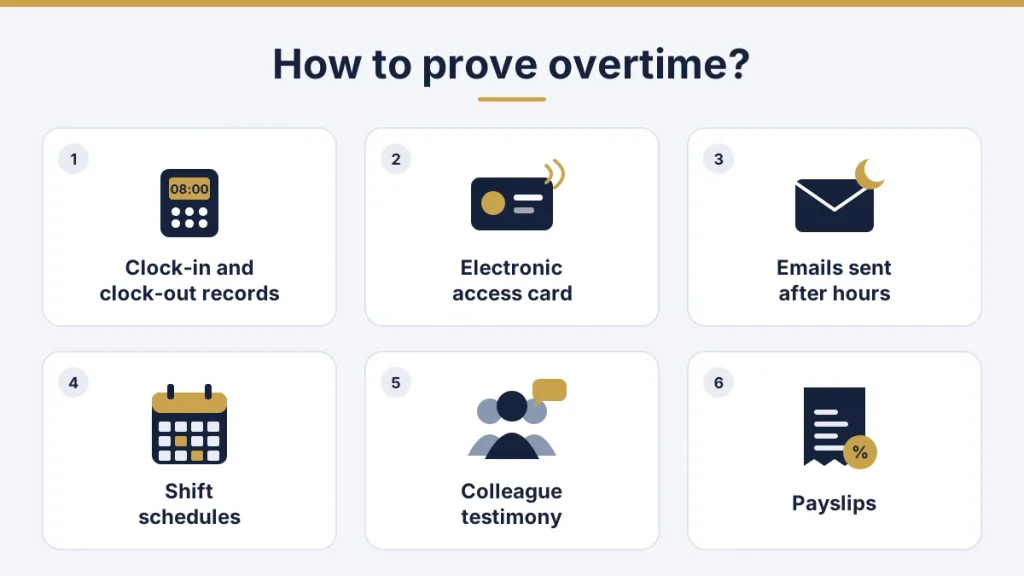
The following may be relevant as evidence:
- records of arrivals at and departures from work;
- electronic access cards for business premises;
- working time records;
- shift schedules;
- emails and business communication sent outside regular hours;
- internal messages and managers’ instructions;
- documentation of completed work;
- testimony of colleagues;
- payslips;
- other data from which it can be determined when the employee actually worked.
If an employee claims to have worked every Saturday for two years from 9 a.m. to 5 p.m., simply making such a claim is not enough. The goal is to reconstruct their working time as precisely as possible.
7. Must there be a written overtime order?
A written overtime order makes proving overtime significantly easier and is good practice for the employer.
However, in real business life, employees often stay after working hours on a verbal instruction from their direct manager, or because they were given a workload that objectively could not be completed during regular working hours.
Therefore, the mere absence of a formal written order should not automatically be equated with the conclusion that there was no additional work.
In a possible dispute, all circumstances and evidence are analyzed.
It is therefore useful for companies to have a clearly defined procedure: who may order overtime, in which cases, how it is recorded and how it is submitted to the accounting department for calculation.
8. Daily overtime records
Records are one of the most important elements of dispute prevention.
They should make it possible to determine when the employee worked, how many hours they worked regularly and how many as overtime.
During labor inspections, particular attention is paid to working time records, work schedules, payslips, overtime decisions and the way employees were informed of them.
Where proper records do not exist, statements may be taken from employees and the employer, and other available evidence may be examined.
9. Overtime and redistribution of working hours are not the same
This is a very important distinction.
With redistribution of working hours, an employee may work longer in one period and shorter in another, so that working time is assessed over the period for which the redistribution was introduced.
Therefore, not every hour above eight hours on a given day is automatically overtime.
But an employer cannot simply claim, only once the employee requests payment for the additional hours, that there was in fact a redistribution. It must be introduced and organized in accordance with the rules that apply to that institution.
10. Overtime and days off
A question that is often asked is:
“Can my employer give me a day off instead of paying for overtime?”
Under the general regime of the Labor Law, the employee’s basic right for overtime is increased pay.
In certain sectors, however, special collective agreements provide for the possibility of converting overtime hours into time off under certain conditions.
The answer therefore also depends on which regulations and collective agreement apply to the specific employee.
11. Overtime in healthcare, education and the Ministry of Interior (MUP)
Special rules apply to certain categories of employees.
In healthcare, for example, on-duty shifts and on-call work may constitute special forms of overtime, and the collective agreement also regulates the possibility of converting overtime hours into time off.
For employees of the Ministry of Interior (MUP), special regulations govern overtime, standby duty and the amount of the salary increase.
In education too, certain rights and the method of recording may be further regulated by special regulations and collective agreements.
This is why, for public sector employees, it is not enough to check only the general Labor Law.
12. Overtime on a business trip
The mere fact that an employee is on a business trip does not mean that every hour from departure to return is overtime.
A distinction must be made between time spent travelling and time during which the employee actually performed work tasks.
If an employee on a business trip performs work after their regular working hours, the question of overtime is assessed according to the actual work and the specific circumstances.
13. Overtime lawsuit
If the employer does not calculate and pay the overtime worked, the employee may demand payment of the unpaid portion of their salary.
In such a dispute, the most important questions are usually:
- whether the employee actually worked longer than regular working hours;
- how many additional hours they worked;
- whether such work was requested by or known to the employer;
- whether it was overtime or another working time arrangement;
- what the value of the unpaid increased pay is.
The proceedings therefore often combine working time documentation, witness testimony and a financial expert’s report for the final calculation of the claim.
It is useful for the employee not to wait until the end of the employment relationship to attempt, for the first time, to reconstruct several years of work. Keeping schedules, records, emails and other data can later be of decisive importance.
14. What is the deadline for filing a lawsuit?
All monetary claims arising from employment, including unpaid overtime, become time-barred three years from the date the obligation arose (Article 196 of the Labor Law). In practice, this means that, as a rule, overtime can be claimed for the last three years – the deadline runs separately for each month in which payment was not made.
The 60-day deadline for initiating a labor dispute (Article 195 of the Labor Law) does not apply to monetary claims, so the employee does not lose the right by not reacting immediately.
The lawsuit is filed with the basic court, and under the Civil Procedure Law labor disputes are handled as urgent.
Before going to court, the parties may also try to resolve the dispute before the Republic Agency for the Peaceful Settlement of Labor Disputes, but this is not a mandatory step.
Do not wait until your employment ends
Many employees raise the issue of overtime only after their employment has ended, when reconstructing several years of work is much harder and part of the claim may already be time-barred. Keeping schedules, records, emails and messages while still employed can later be of decisive importance.
15. FAQ – frequently asked questions
How is overtime paid?
The employee is entitled to increased pay of at least 26% of the base for every hour of overtime.
Is every working Saturday overtime?
No. It depends on the work schedule and the number of hours worked.
Is work on Sunday automatically overtime?
No. Sunday work and overtime are separate issues. However, a special collective agreement or an internal act of the employer may provide for an additional increase for working on Sundays.
How many hours of overtime are allowed?
Under the general regime, a maximum of eight hours per week, provided that the employee’s total working time does not exceed 12 hours per day.
Can I prove overtime without a written order?
It is possible. Work records, electronic communication, access cards, schedules, witnesses and other evidence may be relevant.
Can the employer give days off instead of money?
This should not be assumed to be a universal rule. In certain sectors, such a possibility exists on the basis of special collective agreements and under certain conditions.
Is redistribution the same as overtime?
No. These are two different ways of organizing working time.
16. Conclusion
Overtime is not only a question of how long an employee stayed in the office on a given day. To determine whether there is a right to additional payment, it is necessary to consider the contracted and scheduled working hours, the hours actually worked, the reason for the additional engagement and the way the employer organized the work.
For an employee who has been working longer for months without adequate compensation, the most important thing is to have a way to document that work. Records, schedules, electronic communication and other traces of work are often key when a dispute arises.
For the employer, proper records are equally important. Clear orders, control of the permitted number of hours and correct calculation of increased pay can prevent a question of a few extra hours from turning into a serious labor dispute.
It should be borne in mind in particular that weekend work is not in itself synonymous with overtime, nor does every longer working day automatically mean overtime if a lawfully introduced redistribution of working hours is in place.
This is why, in every specific case, it is first necessary to establish how working time was organized, and only then calculate the employee’s possible claim.
Note: This article is for informational purposes only and does not constitute legal advice for a specific case. The existence and amount of an overtime claim depend on the work schedule, the employer’s documentation, the way work is organized and the circumstances of the specific case.
For specific questions and legal support, please contact the Dvornić law office.