What is an occupational injury?
An injury at work can change your life in a matter of seconds, but what most employees don’t know is that they often don’t exercise their full rights.
On the other hand, employers are exposed to serious penalties and court cases if they do not act in accordance with the law.
Injury at work is regulated by the Labor Law, the Law on Pension and Disability Insurance and other laws and represents any injury to an employee that occurs in connection with the performance of work, that is, during working hours or in circumstances related to work engagement.
In practice, this is one of the most important areas of labor law because it directly affects:
- employee rights (salary compensation, sick leave, damages),
- employer’s obligations (application, liability),
- possible litigation and financial consequences.
Content
- When an injury is considered a work injury
- Obligations of the employer
- Employee rights after injury
- Compensation and liability
- The procedure for reporting an injury at work
- What to do immediately after an injury at work?
- The most common mistakes in practice
- Practical examples
- FAQ – most frequently asked questions
- Conclusion
1. When is an injury considered a work injury?
For an injury to qualify as a work-related injury, there must be a connection to work. This includes:
- injuries caused at the workplace
- injuries during working hours
- injuries on a business trip
- injuries on the way from home to work and vice versa
- injuries during execution of the employer’s order
Important: not every injury is automatically an injury at work — often in practice there is a dispute over this very issue.
2. Obligations of the employer in case of injury at work
The employer has clear legal obligations:
- to respond immediately and provide medical assistance
- to report the injury to the competent authorities (labor inspection, Ministry of Internal Affairs) within 24 hours at the latest of any serious injury or death, or within 5 working days of any minor injury
- to keep records of the injury
- to cooperate with the labor inspection
- to take measures to prevent recurrence
- to inform the employee about the report of the injury at work to the Republic Institute for Health Insurance and the decision on the approval of wage compensation
If the employer does not report an injury at work — this can have serious consequences, including misdemeanor liability that entails a fine in the amount of 1,500,000 – 2,000,000 dinars.
3. Employee’s rights after an injury at work
An employee who suffers an injury at work has a number of rights:
- the right to salary compensation during sick leave in the amount of 100% of the average salary in the previous 12 months
- the right to treatment and rehabilitation
- the right to a disability pension (in severe cases)
- the right to compensation for material and non-material damage from the employer
It is especially important to emphasize:
Damage compensation can include both material and non-material damage (pain, fear, reduction of life activity, annoyance), which is claimed by submitting a claim to the employer or filing a lawsuit in the competent court.
4. Damage compensation – when is the employer liable?
The employer is liable for damages if:
- did not provide safe working conditions
- did not apply regulations on occupational safety
- did not train the employee
- did not provide protective equipment
In a large number of cases, the employer’s responsibility is based on the principle of objective responsibility, which means that the employee does not have to prove guilt, but the existence of damage and a causal connection with work.
5. How to report an injury at work?
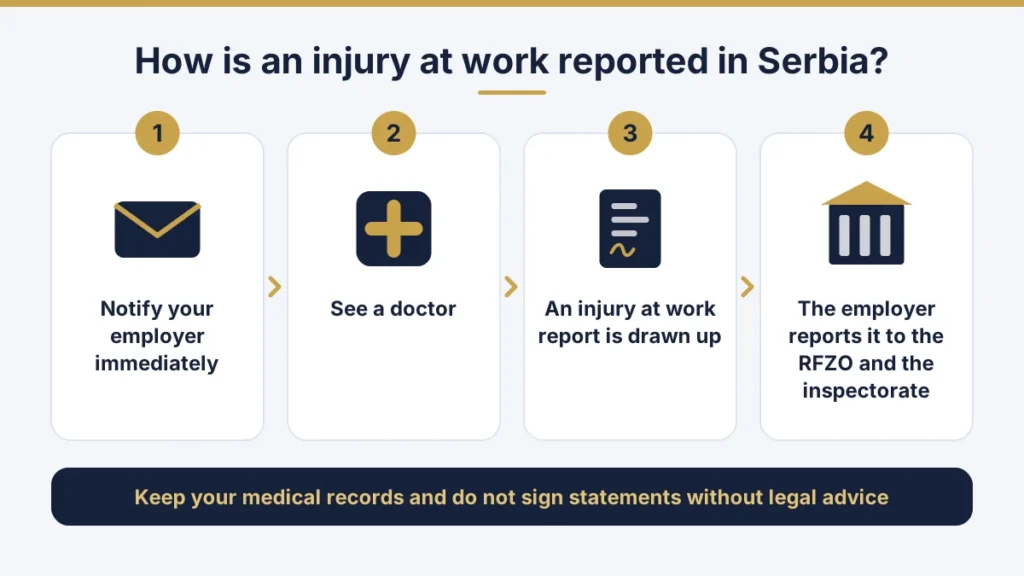
- Notifying the employer
- Going to the doctor
- Completing an injury report
- Application to RFZO by the employer
- Possible inclusion of labor inspection
Important:
Deadlines are short, and failure to do so may result in loss of rights.
6. What to do immediately after an injury at work?
- notify the employer immediately
- seek medical help
- request that the injury be recorded
- save medical documentation
- provide witnesses
- do not sign statements without legal advice
7. The most common mistakes in practice
From experience working with clients, the most common mistakes are:
- not reporting the injury on time
- signing unfavorable statements
- lack of evidence (witnesses, documentation)
- accepting minimum compensation without legal advice
For employers:
- avoiding injury reporting
- failure to keep records
- poor organization of occupational health and safety
- misdemeanor liability
8. Practical examples from practice
Example 1: Injury on the way to work – is it recognized?
The employee traveled to work every day by public transport. One morning, while getting off the bus and going to work, he slipped on the icy surface and injured his leg.
The employer initially took the position that it was not an injury at work, with the explanation that the injury did not occur on the premises of the company.
However, through legal analysis it was established:
- that the injury occurred on the usual way to work,
- that the employee went directly to work without interruption,
- if there were no private activities that would break the causal link.
Outcome: The injury was recognized as a work-related injury, and the employee was entitled to salary compensation during the sick leave and started proceedings for compensation.
Key lesson:
An injury at work does not have to occur on the employer’s premises — the decisive factor is the connection with work.
Example 2: Lack of protective equipment – employer’s responsibility
The worker in the production facility worked on the machine without adequate protective equipment (protective gloves and shields). An arm was injured during work.
The employer claimed that the worker had been warned and was responsible for the injury.
In the procedure, it was established:
- that the employer did not provide the appropriate equipment,
- that adequate occupational safety training was not conducted,
- that there was no written evidence of warnings to the employee.
Outcome: The court determined the employer’s responsibility and awarded compensation to the employee (material and non-material).
Key lesson:
The employer has an active duty to provide safe working conditions — it is not enough to simply warn the employee.
9. FAQ – most frequently asked questions
1. Am I entitled to compensation if I am at fault for the injury?
In certain cases — yes. Everything depends on the circumstances and the employer’s responsibility, but even when the employer’s responsibility exists, the court in civil proceedings can determine the employee’s contribution to the damage and thus reduce the employer’s responsibility.
2. How long does the damage collection procedure take?
It can last from several months to several years, depending on the complexity of the case and the promptness of the competent court.
3. Do I have to sue the employer?
Not necessarily — it is often possible to reach an agreement with the mediation of a lawyer out of court and settle on the payment of damages, in which case the procedure can last from a few days to a few weeks.
4. What if the employer did not report the injury?
This does not affect your right — but it requires additional steps in proving and entails the employer’s misdemeanor liability in the amount of 1,500,000 – 2,000,000 dinars according to the Law on Occupational Safety and Health.
5. Does a foreigner employed in Serbia have the same rights?
Yes, if a foreigner has a regulated residence based on a single permit or temporary residence and has concluded an employment contract, the law applies equally to all employees.
10. Conclusion: How to protect yourself in time
An injury at work is not only a health problem — it’s also a legal issue that can have long-term consequences.
The most important thing is:
- react immediately
- collect documentation
- do not sign anything without understanding
- consult a lawyer in time
A timely response often makes the difference between minimal and full compensation.
If you have suffered an injury at work or want to protect your business from potential risks, you can contact us for legal analysis and advice.
Note: This blog is for informational purposes only and does not constitute legal advice. For specific questions and legal support, please contact the Dvornić law office.