What is the labor regulation and why is it so important
The work regulations represent the employer’s general act, one of the basic internal acts of every employer. It regulates in more detail the rights, obligations and responsibilities of employees, work organization, work discipline, working hours, vacations, wages and numerous other issues related to employment related to all employees who work and will work for a certain employer.
In practice, the work regulations are much more than a formal document.
It represents the legal framework of the company’s daily functioning. When the rules are clearly set, relations within the collective are more stable, the risk of conflict is lower, and the employer has a far stronger legal position in situations where a dispute arises.
The biggest mistake is to view the rulebook as an “administrative obligation”. Its true value is only seen when there is a problem.
Content
- Is the labor regulation mandatory under the Labor Law?
- Key elements of the work regulations
- How the work regulations are adopted
- The most common legal mistakes of employers
- Why the rule book has a lot of weight in court cases
- A practical example from business
- FAQ – the most frequent questions of employers and employees
- Conclusion – the rulebook as a mechanism of legal certainty
1. Is the labor regulation mandatory under the Labor Law?
One of the most common questions in practice is: does the employer have to have a work rule book?
The Labor Law of the Republic of Serbia prescribes situations in which the adoption of regulations is mandatory, but also those in which there is no formal obligation, most often these are cases of state bodies that have signed collective agreements and there is no obligation to adopt labor regulations. However, from the point of view of legal certainty, almost every employer has a strong reason to adopt it.
Without work regulations, problems such as:
- unclear rules of employee behavior
- difficult sanctioning of violations of work obligations
- weaker position of the employer in the dispute
- increased risk before the labor inspection
The question arises why the employer should have a work rule book, when the rights and obligations of the worker are already regulated by the Labor Law, ie contained in the work contract? The answer, however, is that the Labor Law in many places leaves freedom and the possibility for the employer to regulate rights and obligations differently in accordance with his business, and the employment contract is also relieved, which in that case does not have to contain numerous and extensive provisions, because they are regulated by the labor regulations.
An important note is that the labor regulations must not give employees fewer rights or greater obligations than the rights regulated by the Labor Law, otherwise certain provisions will be considered invalid and the Labor Law will be applied directly.
2. Key elements of the work regulations
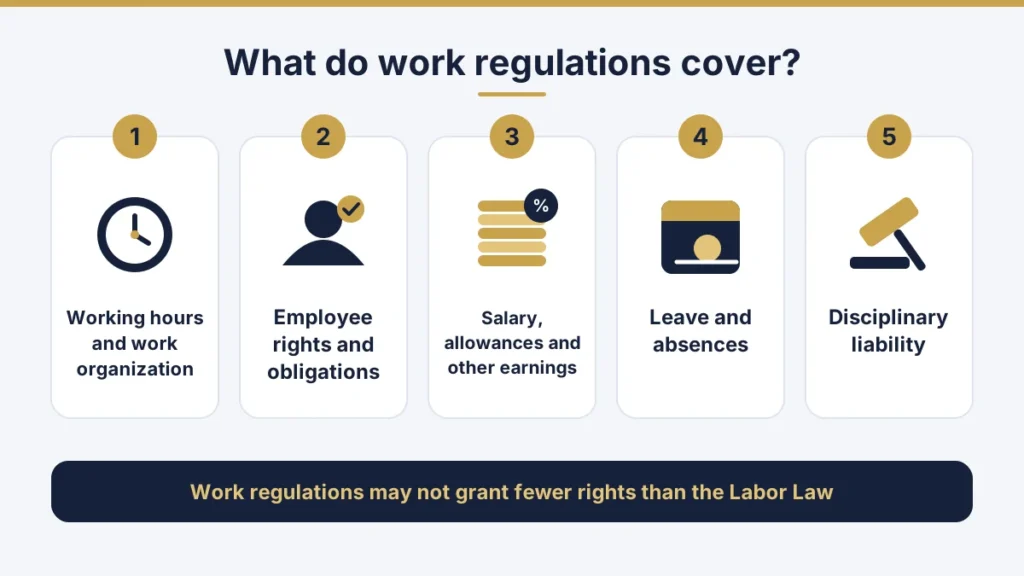
A good work regulation must be precise, applicable and adapted to the specific company. Generic documents downloaded from the Internet are almost never the optimal solution.
The Labor Rulebook gives the employer the opportunity to have certain provisions of the Labor Law that are not sufficiently regulated, be done by the employer himself in accordance with the law.
The most important areas that the regulation typically regulates are:
Working hours and organization of work
One of the most common sources of misunderstanding between employees and employers. The Rulebook defines the working time schedule, overtime, shifts, attendance records and other operational issues.
Clear rules mean fewer conflicts and fewer legal risks.
Rights and obligations of employees
This part of the rulebook has enormous practical value. It specifies standards of behavior, responsibilities of employees, attitude towards work tools, confidential information and work discipline.
These provisions often play a key role in disciplinary proceedings.
Salary, allowances and other income
Transparent rules regarding earnings significantly reduce the possibility of disputes. The Rulebook can elaborate in more detail the issues of calculation, salary supplements and other incomes.
Vacations and absences
The Rulebook regulates the procedures for using annual leave, paid and unpaid leave, sick leave and similar situations that are inevitable in any work environment.
Disciplinary responsibility and violations of work obligations
One of the most important sections of the rulebook. If violations of work obligations are not clearly defined, the employer may have serious problems when imposing measures or giving notice.
It is also important to emphasize that the employer has the right, in accordance with the labor regulations, to prescribe other violations of labor discipline and obligations as a reason for termination, in addition to the violations specified by law.
For example, the employer can provide a rude attitude towards the client in the work regulations as a violation of work discipline, which is a reason for dismissal.
3. How the work regulations are adopted
The work regulations are usually drawn up by specialized persons, lawyers or lawyers in cooperation with the director, HR department or the owner of the company.
When the work rulebook is ready, an authorized person in the company, usually the director, signs it and publishes it on the notice board in the company so that the rulebook is available to all employees and newly hired persons.
The employer can amend the work regulations in two ways:
- by adopting the Rulebook on Amendments to the Work Rulebook or
- by the adoption of a new Rulebook on Work, which supersedes the old rulebook.
4. The most common legal mistakes of employers
Through work with companies, typical patterns of errors are observed:
Copying the rules without adaptation
Each company has specifics. The rulebook must reflect the real organization of work, not an abstract model.
Vague and overly general wording
In legal disputes, general provisions have very limited value. Accuracy is crucial.
Non-compliance with the Labor Law
The internal act must not be contrary to compulsory regulations. Such provisions do not produce legal effect and may generate additional risks, i.e. lawsuits against employers.
The rulebook exists, but it is not applied
The courts and the labor inspectorate observe the actual behavior of the employer. A document that exists only formally does not provide real protection.
5. Why the rulebook has a lot of weight in court cases
In labor disputes, the labor regulations often become the central evidentiary document. Its provisions allow the court to assess:
- whether the rights and obligations were clear
- whether the employee was familiar with the rights and obligations from the regulations
- whether the employer acted legally
In the absence of regulations, the employer’s evidentiary position can be significantly weakened
6. A practical example from business
The employee does not respect working hours and is often late. The employer wants to react.
If the rulebook precisely defines the working hours and the consequences of the violation of work obligations – the legal basis is stable and the employer, with the appropriate procedure, can start the procedure for giving notice of the employment contract to the employee.
If the regulation does not exist or is unclear → the employer can hardly fire the employee and the risk of a successful lawsuit by the employee against the employer for illegal dismissal increases.
Such situations are extremely common in practice.
7. FAQ – most frequently asked questions
Does every company have to have a labor regulation?
The legal obligation depends on the specific situation, but the rulebook is highly recommended for almost every employer, especially if there are more than 10 employees and no collective agreement.
Can the rulebook be a simple document?
It can, but it must not be superficial. Legal precision is more important than scope.
Does the regulation only protect the employer?
No. The rulebook also protects employees because it ensures the transparency and predictability of the rules.
When should the rulebook be changed?
In the case of changes in the law, work organization or when practice shows the need to specify the rules.
8. Conclusion – the rulebook as a mechanism of legal security
The work rules are one of the most important internal acts in any organization. Its function is not bureaucratic, but strategic: prevention of disputes, clear definition of rules and strengthening of legal certainty.
Organized working relationships almost always mean less conflict, less risk and more stable business.
For all additional information and legal support, the Dvornić law office is at your disposal.
Note: This blog is for informational purposes only and does not constitute legal advice. For specific questions and legal support, please contact the Dvornić law office.