Contents
- What is an employment contract annex
- When is an employment contract annex concluded
- The difference between an annex and a new employment contract
- Can the employer change the employment contract unilaterally
- What a lawful procedure for concluding an annex looks like
- The most common examples of employment contract annexes in practice
- Delivering the notice and the proposed annex
- Refusing the annex – employee rights
- Dismissal for refusing an annex – when is it unlawful
- The most common mistakes made by employers and employees
- FAQ – Most common questions about employment contract annexes
- Conclusion
1. What is an employment contract annex
An employment contract annex is a written legal act that amends or supplements certain provisions of an existing employment contract, while the rest of the contract remains unchanged.
In practice, an annex is used when, during employment, there is a need to change certain working conditions without concluding an entirely new contract.
An employment contract may be amended by an annex only in the cases provided for by law or the employer’s rules. The employer cannot change the employment contract at its own discretion.
The most common changes made by an employment contract annex concern:
- the amount of salary,
- the job position or job description,
- the place of work,
- the duration of employment,
- working hours,
- the duration of the contract (within the limits of the law),
- work organization (remote work, hybrid model).
👉 Important: An annex has the same legal force as the employment contract and forms an integral part of it.
2. When is an employment contract annex concluded
An employment contract annex is concluded when there is an objective need to adjust working conditions without affecting the very basis of the employment relationship.
The most common reasons are:
- business reorganization,
- promotion or reassignment of the employee,
- a change in salary,
- a change of work location,
- switching to a different work model.
An annex allows flexibility, but only if it is used in accordance with the law and with respect for the employee’s rights.
3. The difference between an annex and a new employment contract
Although they are often confused, an employment contract annex and a new contract are not the same.
Employment contract annex:
- changes only certain provisions of the employment contract,
- does not interrupt the continuity of employment,
- is simpler and safer in practice.
New employment contract:
- changes the entire legal relationship,
- may have consequences for length of service and rights,
- is used only when the very essence of the work changes.
👉 In practice, the rule is:
the “shallower” the changes, the more appropriate an annex is.
4. Can the employer change the employment contract unilaterally
The employer cannot unilaterally change the essential elements of the employment contract.
This applies in particular to:
- salary,
- working hours,
- place of work,
- the duration of employment
- the type and description of work, etc.
Each of these changes requires the employee’s express consent, which is given by signing the annex.
In accordance with the Labor Law the employer is obliged to deliver to the employee, together with the annex, a written notice that sets out the reasons for the proposed annex, the deadline within which the employee must respond to it and the legal consequences that may arise from not signing the annex.
⚠️ Exceptions exist only in situations strictly prescribed by law and are, as a rule, temporary.
5. What a lawful procedure for concluding an annex looks like
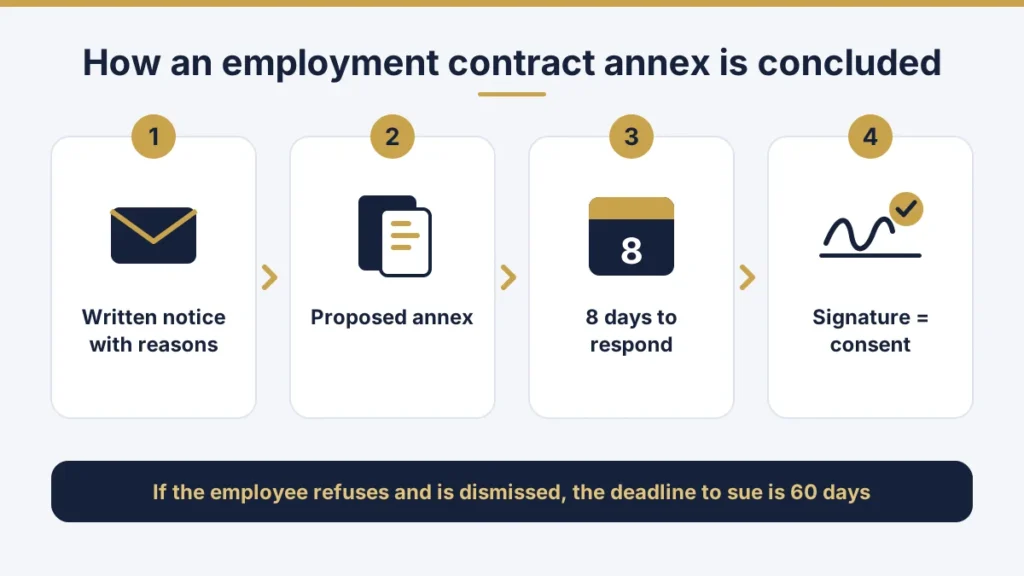
A lawful employment contract annex must go through a clear procedure.
In practice, this means:
- The employer delivers a written notice / offer to conclude the annex
- A written proposal of the annex is delivered together with that notice
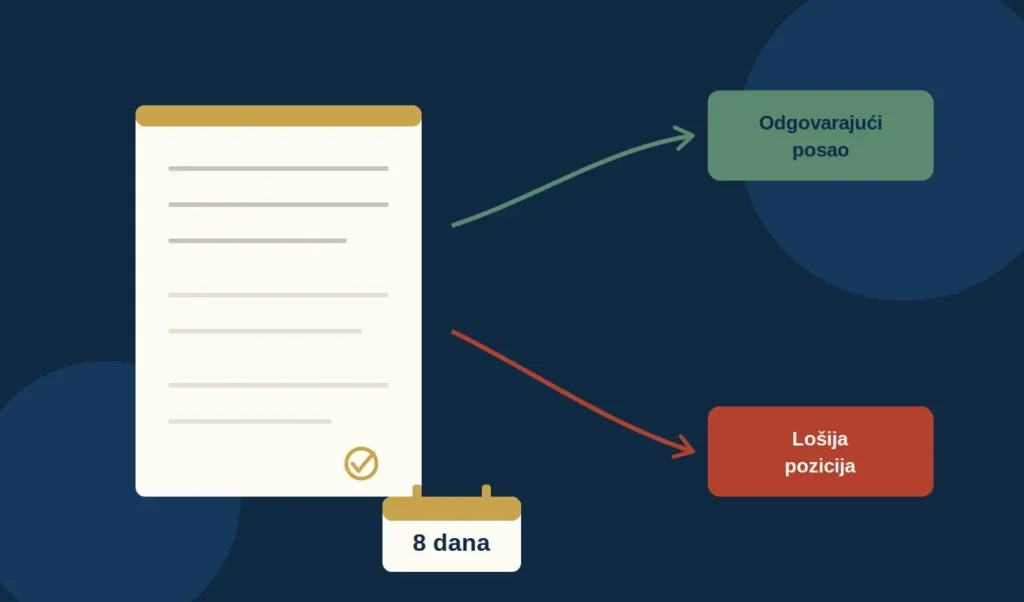
- The employee has 8 days to sign or refuse to sign the employment contract annex
- The annex is concluded only with the employee’s consent
- The signed annex takes effect from the date of signing or from the date specified in the annex
- The annex becomes part of the employment documentation
If any of these steps is missing, the annex may be challenged in court.
The Labor Law provides that, even if the employee signs the proposed annex, they retain the right to file a lawsuit with the competent court to challenge that same annex.
6. The most common examples of employment contract annexes
✔ Change of salary
– increase or decrease (with a stated reason and the employee’s consent)
✔ Change of job position
– moving to a managerial or another operational position
✔ Remote or hybrid work
– specifying the place of work, supervision and costs
✔ Change of working hours
– full time ↔ part time
In all these cases, a written annex is necessary.
7. Delivering the notice and the proposed annex
The offer, i.e. the notice for concluding the employment contract annex, together with the proposed annex, is delivered in person to the employee at the workplace or sent by registered mail to their home address.
It is important for the employer to have signed proof of delivery to the employee, which is usually a signed copy of the delivered notice or a postal return receipt proving that the employee received the notice and the annex.
If the employer cannot deliver the notice and the annex to the employee in the ways described above, the employer must draw up a written note and post the notice with the annex on the employer’s notice board, and after 8 days the documents are deemed delivered to the employee.
8. Refusing the annex – employee rights
The employee has the right to refuse to sign the employment contract annex, i.e. not to sign it within 8 days of delivery.
However, in that case the Labor Law also provides that the employer has the right to terminate the employment if the employee refuses to sign the proposed annex, while the employee retains the right to file a lawsuit against such dismissal.
This is precisely the stage at which most disputes arise.
9. Dismissal for refusing an annex – when is it unlawful
Dismissal for refusing to sign an annex is among the most common grounds for unlawful dismissal in case law.
The dismissal is unlawful if:
- the annex was not justified by real business reasons,
- the annex worsens the employee’s rights without grounds,
- the procedure prescribed by law was not followed,
- the annex is used as a means of pressure on the employee.
In such cases, the employee has the right to:
- initiate a labor dispute within 60 days from the day the decision terminating their employment contract is delivered,
- request annulment of the dismissal, and thereby of the unlawful annex
- claim damages and lost wages, as well as reinstatement.
Courts examine in particular whether the annex was a real need or a disguised attempt to reduce the employee’s rights.
Example 1:
If, following a lawsuit filed by the employee, the court rules that the annex signed by the employee with the employer is unlawful, the court will order the employer to:
- restore the employee’s previous working conditions (e.g. return them to their previous position)
- pay the salary difference if the unlawful annex reduced the employee’s salary
Example 2:
If the employee refuses to sign the proposed employment contract annex and the employer therefore dismisses them, and the employee obtains a court judgment declaring the annex and therefore the dismissal unlawful, the employee has the right to return to work under the previous conditions, as if they had never been offered the annex.
10. The most common mistakes in practice
❌ Verbal agreements without a written annex
❌ Annexes that do not clearly state what is changing
❌ Not giving the employee a deadline
❌ Using generic templates
❌ “Pressuring” the employee to sign
All these mistakes often lead to court disputes that employers lose.
11. FAQ – Most common questions about employment contract annexes
Does an annex have to be in writing?
Yes. A verbal annex has no legal effect.
Do I have to sign the annex?
No. Signing must be voluntary.
Do I have to sign the annex immediately upon delivery?
No. The employer must give you 8 days to sign or refuse to sign the annex.
Does the annex have to be delivered in person?
Yes, it does. If it cannot be delivered to you in person, it may be sent by registered mail to your home address and, as a last resort, you may be notified via the employer’s notice board.
Can an annex reduce my salary?
It can, but only with the employee’s consent and a lawful reason.
Does refusing an annex mean dismissal?
Not automatically, but the employer has a legal basis for terminating the employment contract. Dismissal in these situations is often unlawful and can be challenged within 60 days from the day the dismissal decision is delivered to the employee.
How many annexes can there be?
There is no limit, but frequent changes may indicate abuse.
12. Conclusion
An employment contract annex is a useful instrument for both employers and employees — but only if it is used lawfully, carefully and transparently.
For employees, it can be a signal for caution.
For employers, a poorly drafted annex often means a long and costly court dispute.
If you are in a situation where you:
- are considering signing an annex,
- have refused an annex and are facing dismissal,
- want to properly regulate employment relations in your company,
It is important to react in time. In labor disputes, the deadline for filing a lawsuit is only 60 days, and if it is missed, the employee may lose the possibility of protecting their rights in court. That is why a timely legal assessment is often key to the outcome of the entire procedure.
For any additional information and legal support, the Dvornić law office is at your disposal.
Note: This blog is for informational purposes only and does not constitute legal advice. For specific questions and legal support, please contact the Dvornić law office.