Contents
- Introduction
- What is termination of an employment contract
- Who can make the decision on termination
- Grounds for dismissal by the employer and their specifics
- Dismissal procedure – what it looks like in practice
- Employee rights after dismissal
- How employers can carry out a dismissal properly
- The most common mistakes in practice
- Judicial protection and deadlines
- Examples from practice
- FAQ – frequently asked questions
- Conclusion
1. Introduction
Termination of an employment contract is one of the most sensitive topics in labor law. It directly affects the employee’s livelihood, but also the organization of the employer’s business. A properly conducted dismissal can prevent lengthy disputes and unnecessary costs, while an unlawful dismissal often leads to lawsuits, misdemeanor proceedings, high damages and reputational problems.
This article is a practical guide for employees and employers — what dismissal is, how the procedure works, what rights and obligations exist, who can terminate the contract, what the Labor Law says and what practice looks like in Serbia.
2. What is termination of an employment contract
Termination of an employment contract is a unilateral declaration of will that ends the employment relationship, which may be ended only in the cases set out in the Labor Law. A dismissal must be:
- In writing
- reasoned
- delivered to the employee
The Labor Law clearly sets out the basic conditions and the procedure in order to protect both parties.
3. Who can make the decision on termination
Employment can be terminated:
- by dismissal by the employer, which requires a legal ground
- by resignation of the employee, for personal reasons
- by mutual agreement
The employee does not have to give reasons for resigning, while the employer does. This is one of the key differences in labor law.
4. Grounds for dismissal by the employer and their specifics
An employer may terminate an employment contract only in cases prescribed by law, which in practice means that an employer cannot simply dismiss an employee. In this regard, the Labor Law recognizes several grounds for termination of the employment contract by the employer, namely:
a) Reasons relating to the employee’s working ability and conduct
Examples:
- the employee lacks the necessary knowledge or does not achieve work results
- if they have been finally convicted of a criminal offense at work or in connection with work
- if they do not return to the employer within 15 days after the end of the suspension of employment or unpaid leave
b) Breach of work duties
The law provides that the employer may terminate the employment contract where the employee:
- performs their work duties negligently or carelessly
- abuses their position or exceeds their authority
- uses work equipment irresponsibly
- breaches other work duties set out by the employer in the work regulations or the employment contract, and other cases prescribed by law.
c) Breach of work discipline
As grounds for dismissal, the law provides for reasons relating to employees’ failure to respect work discipline, which include:
- refusing to perform work and carry out the employer’s instructions
- failure to submit proof of temporary incapacity for work (failure to submit a sick note in case of illness)
- abuse of sick leave
- coming to work under the influence of alcohol or narcotics
- providing false information when entering into employment
- breach of work discipline prescribed by the work regulations or the employment contract, etc.
d) Technological, organizational and economic reasons (redundancy)
The Labor Law also provides that the employer may dismiss an employee for reasons relating to the employer, i.e. its business, if, as a result of:
- technological,
- economic or
- organizational changes the need to perform a certain job ceases or the volume of work is reduced.
In this case, the employer may also dismiss an employee when it offers an annex to the employment contract and the employee refuses to sign the proposed annex. In that case, the employee has the right to sue the employer and seek annulment of the dismissal within 60 days.
e) Resignation by the employee
An employee may resign at any time, and this is the simplest form of termination, which is submitted in writing. In the written resignation, the employee does not have to state a reason, but must state the date on which the employment ends.
The employee must also observe the notice period, and if they do not observe the statutory period, in certain cases the employer may be entitled to compensation for material damage from the employee.
f) Mutual termination
Unlike dismissal by the employer or resignation by the employee, which is a unilateral declaration of will, mutual termination, as the name suggests, is an agreement, i.e. a meeting of minds between the employee and the employer to end the employment.
In that case, the employee and the employer conclude and sign a termination agreement stating the date on which employment ends, which may be the same day the agreement is signed or another date.
Very important note: before signing this agreement, the employer is obliged to inform the employee in writing of the consequences in the event of unemployment, namely that the employee will not be entitled to unemployment benefit from the National Employment Service (unemployment insurance).
Unlike redundancy and dismissal for business reasons, the employer has no legal obligation to pay severance pay in the case of mutual termination. However, in practice it is often agreed.
5. Dismissal procedure – how dismissal is carried out in practice
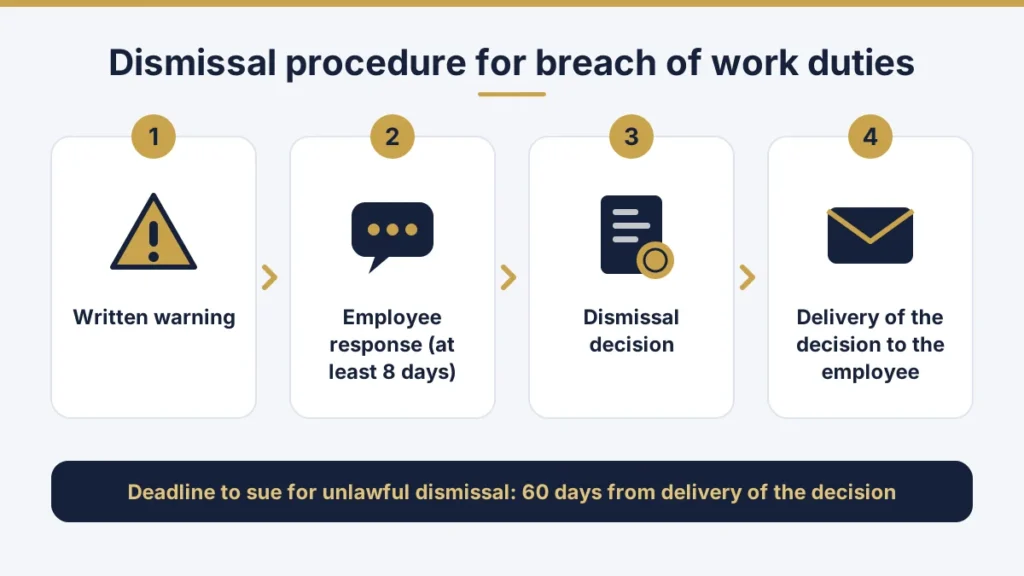
Most court disputes arise because employers did not follow the procedure, not because there was no reason for dismissal. Depending on the reason for dismissal, the Labor Law prescribes different procedures for dismissal in the form of a dismissal decision.
- The procedure for dismissal due to breach of work duties and work discipline includes the following:
- Written warning (for disciplinary reasons)
- The employee’s response within 8 days of receiving the warning
- Dismissal decision
- Delivery of the decision
- Employment ends on the same day the decision is delivered to the employee
- Calculation and payment of wages
- Dismissal procedure for failure to achieve results or lack of the necessary knowledge:
- Delivery of a notice – contains a notice of the shortcomings in the employee’s work, instructions for correcting them and a deadline for improvement
- Dismissal decision – if the employee does not act on the notice
- Notice period stated in the dismissal decision
- Delivery of the decision
- Dismissal procedure in case of redundancy:
- Amending the job classification rulebook – the employer abolishes certain positions or organizational units, or reduces the number of employees in them
- Preparing an explanatory report – the employer describes in detail what changes have occurred
- Adopting a Redundancy Program – for larger layoffs in production, factories,
- Determining criteria for selecting employees for dismissal – including work performance, work engagement, expertise or the employee’s financial situation, number of dependants, etc.
- Dismissal decision
- Delivery of the decision
Specifically, in this type of termination, the employee is entitled to severance pay of no less than 1/3 of the salary for each year of service with the employer.
Key: everything must be in writing and documented.
6. Employee rights after dismissal
After termination of the employment contract, the employee is entitled to:
- calculation and payment of unpaid wages and salary compensation
- use of unused annual leave or monetary compensation for unused leave
- any severance pay
- unemployment benefit from the National Employment Service (if the conditions are met)
- judicial protection against unlawful dismissal
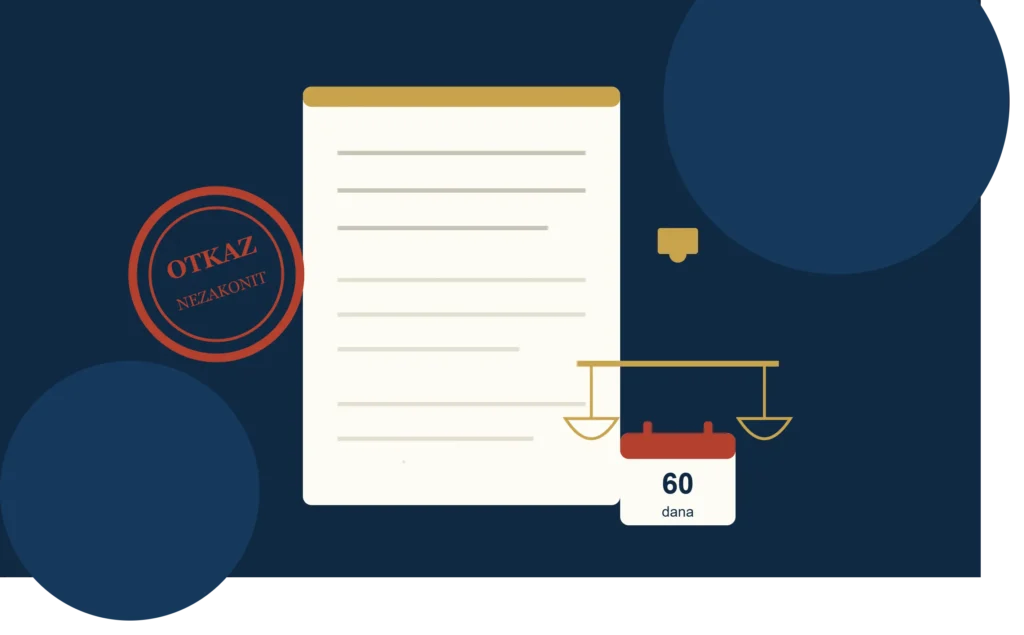
The Labor Law allows 60 days to initiate a dispute over unlawful dismissal from the moment the dismissal decision is delivered.
7. How employers can carry out a dismissal properly
For employers, the following are key:
- Professionally drafted employment contracts
- Having work regulations, a job classification rulebook, etc.
- following the dismissal procedure
- issuing reasoned dismissal decisions
- legal preparation
- HR training
- written warnings and notices
- consulting a lawyer
This avoids costly mistakes in the form of potential court disputes, misdemeanor proceedings, fines and reinstatement of employees.
8. The most common mistakes in practice
By employers:
❌no legal ground for dismissal
❌the employer did not follow the statutory dismissal procedure
❌ verbal “you’re fired”
❌ no warning
❌ unreasoned dismissal decision
❌ wrong legal ground
❌ unpaid severance
❌ incorrectly calculated notice period
By employees:
❌ passivity
❌ not knowing the deadlines
❌ not consulting an expert
❌ signing an agreement without checking it
9. Judicial protection and deadlines
If the employee believes the dismissal is unlawful:
- they have the right to file a lawsuit
- deadline: 60 days from receipt of the dismissal decision
- the court may annul the dismissal,
- reinstate the employee,
- award unpaid wages + contributions,
- recognize severance pay,
- award legal costs
Due to the length of court disputes and to avoid costs, employers and employees often reach out-of-court settlements through their lawyers.
10. Examples from practice
Example 1 – employee
An employee was dismissed for “poor results”. The court found that the employer had no defined criteria, had not delivered a written notice and had not followed the dismissal procedure. The dismissal was annulled as unlawful. The employee was reinstated and paid the outstanding wages.
Example 2 – employer
The company closed a department, amended its job classification act, set criteria, paid severance and followed the procedure. There was no dispute.
11. FAQ – frequently asked questions
Can an employer dismiss an employee without any reason?
No, an employer may dismiss an employee only where there is a reason prescribed by the Labor Law.
Do I have to work during the notice period?
Yes, unless you agree otherwise with the employer.
When am I entitled to severance pay?
In the case of dismissal due to redundancy and upon the employee’s retirement.
Can I start a dispute to challenge the dismissal?
Yes, within 60 days from the day the dismissal decision is delivered.
What if I don’t want to sign the dismissal?
Your signature is not a condition for the employment to end. What matters is that the decision has been delivered to you.
Can I return to work after the dispute?
You can, if the court annuls the dismissal. The employer is then obliged to reinstate the employee and compensate for the lost wages.
Must the employer give reasons for the dismissal?
Yes. The law requires a statement of reasons, except in the case of resignation by the employee.
12. Conclusion
The Labor Law, adopted many years ago, unfortunately often fails to keep up with modern labor market trends. This makes it harder for both employers and employees to exercise their rights, as well as to carry out procedures in practice. At the same time, the existing legislation remains incomplete in many areas of labor law, so its application relies heavily on the opinions of the competent ministries, conclusions and case law, which continue to fill the gaps in the law.
In such a legal environment, the role of professionals — lawyers, legal advisors and HR specialists — becomes key to the correct application of regulations, proper implementation of procedures and precise drafting of employment documentation, risk prevention and avoiding potential disputes that can be costly for both parties.
For any additional information and legal support, the Dvornić law office is at your disposal.
Note: This blog is for informational purposes only and does not constitute legal advice. For specific questions and legal support, please contact the Dvornić law office.