📚 Article contents:
- What is a supplementary work contract?
- Who can conclude this contract and under what conditions
- How long supplementary work can last and how it is calculated
- Rights and obligations of the employer and the employee
- The most common examples from practice
- FAQ – the most common questions from practice
- Conclusion: When is supplementary work a smart solution?
Introduction: Flexible engagement with legal certainty
The modern labor market demands flexibility, but also legality. Whether you are an employee who wants to earn extra money, an employer who wants to engage additional help, or an HR manager looking for a solution that complies with the law – a supplementary work contract may be the right choice.
In this article, we explain how this contract works in practice, what its limitations and benefits are, with concrete examples and the most common questions.
1. What is a supplementary work contract?
A supplementary work contract (ugovor o dopunskom radu) is work outside an employment relationship, a special contract concluded with an employee who already has an employment contract with another employer, and it can be concluded for no more than one third of full working hours.
Persons working under supplementary work arrangements do not have the status of employees and are therefore not equal to employees in their rights and obligations. They are not paid a salary, but a fee.
Key features:
- Concluded in writing
- Does not require deregistration from the existing company
- The work is performed outside regular working hours with the primary employer
- This may be regular work related to the employer’s business activity, i.e. jobs included in the job classification, but also any other work
- An employee cannot have both an employment contract and a supplementary work contract with the same employer.
2. Who can conclude a supplementary work contract?
Employee:
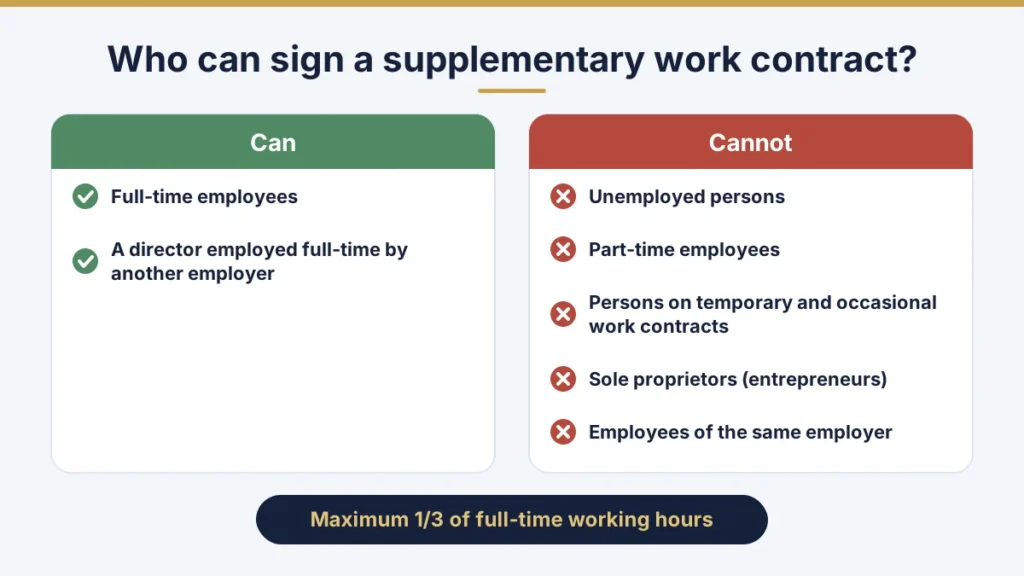
- Must already have an employment contract with the primary employer
- must work full time for the existing employer (40 hours per week)
- May work a maximum of one third of full working hours for another employer
- Does not need the consent of their primary employer, except in the case of healthcare workers, where the employee must notify the director or owner of the healthcare institution of the conclusion of the supplementary work contract.
Employer:
- May engage a person already employed by another company
- Is not obliged to register the employee with the Central Register of Compulsory Social Insurance (CROSO), since that person is already registered on the basis of the employment contract.
It follows from the above that a supplementary work contract cannot be concluded with an unemployed person, nor with a person working part time.
This contract also cannot be concluded with a person working under a contract for temporary and occasional work, because such a person is not in an employment relationship.
Likewise, a sole proprietor (entrepreneur) cannot conclude a supplementary work contract, given that they do not have the status of an employee within the meaning of Article 5 of the Labor Law.
A director may conclude a supplementary work contract if employed full time by another employer, but, as we said, for up to one third of full working hours.
3. How long can supplementary work last and how is it calculated?
A person engaged under a supplementary work contract works full time under an employment contract with the existing employer + up to 1/3 of working hours under a supplementary work contract with another employer.
A supplementary work contract may be fixed-term (e.g. for a season, a project, temporary work) or open-ended, as is the case with a service contract, provided that the conditions for concluding a supplementary work contract are met.
In this case, the person is entitled to a fee, not a salary, and in addition to the Labor Law, the provisions of the Law on Obligations also apply to this contract, which regulates, among other things, the grounds for terminating the contract, i.e. the conditions for its rescission and termination.
4. Rights and obligations under a supplementary work contract
Since persons who have concluded a supplementary work contract do not have the status of employees, they accordingly have no right to annual leave, paid leave, sick leave or the minimum wage. Nor are they entitled to a meal allowance, holiday bonus or reimbursement of transport costs.
Rights of the employee:
- The right to a fee
- The right to health and safety protection at work
- The right to have working hours recorded
Obligations of the employer:
- Keeping work records
- Paying the fee in accordance with the contract
- Ensuring safe working conditions
5. Practical examples:
- A dentist at a state clinic who works in a private practice in the afternoon – engaged through a supplementary work contract.
- An IT engineer who wants to work as a consultant for a startup at weekends – legal and flexible.
- A teacher who gives training sessions at a private language school in their free time – in compliance with the law, without fictitious service contracts.
6. FAQ – Most common questions
1. Are taxes and contributions paid?
No, because the person is already insured with the primary employer on the basis of the employment contract, so the second employer is not obliged to file a registration on the CROSO portal.
2. Can I do supplementary work without my primary employer’s knowledge?
If the employment contract or the company’s internal act does not prohibit it, you can. It is recommended to check the work regulations or obtain direct consent.
3. Can I have several supplementary work contracts?
It is possible, but the total must not exceed ⅓ of full working hours, combined across all employers.
4. Does this contract give the right to annual leave, sick leave and the like?
The law does not provide for full rights as with an employment contract, so in that sense the person does not have these rights.
5. How is a supplementary work contract terminated?
In accordance with the general rules of the Law on Obligations and the Labor Law – notice period, agreement, expiry of the term, etc., as well as when the employee’s employment with the first employer ends.
7. Conclusion: When is supplementary work a smart choice?
A supplementary work contract is an excellent solution when:
- The employee wants additional income without jeopardizing their main job
- The employer needs additional staff, but not full time
- A flexible and lawful form of engagement is needed
If applied correctly, this contract provides security for both the worker and the employer, without the need for “workarounds” that may be legally risky.
Note: This blog is for informational purposes only and does not constitute legal advice. For specific questions and legal support, please contact the Dvornić law office.