What is the right to annual leave?
The right to annual leave is one of the basic rights of every employee regulated by the Labor Law. Its purpose is not only to take a break from daily work duties, but to preserve the employee’s health, safety and working ability.
Although in practice the number of days of annual leave or the possibility of carrying it over to the next year is often discussed, one question in particular is often asked: what happens if an employee does not use annual leave?
Does the employer have to pay compensation? Can an employee ask for money instead of vacation? What if the employment relationship ends before the annual leave is taken?
In the following, we answer the most important questions and explain the rights of employees and the obligations of employers when it comes to annual leave and compensation for unused days.
Text content:
- Who is entitled to annual leave?
- When is an employee entitled to compensation for unused annual leave?
- Can the employer pay annual leave instead of using it?
- What happens to annual leave when an employee resigns or terminates his employment?
- How is compensation for unused annual leave calculated?
- The most common mistakes of employees and employers
- FAQ – most frequently asked questions
- Conclusion
1. Who is entitled to annual leave?
Every employee who has established an employment relationship has the right to annual leave, regardless of whether it is a fixed-term contract or an indefinite-term contract.
The length of annual leave depends on several factors, such as:
- working conditions;
- work experience;
- vocational training;
- employee contribution;
- other criteria prescribed by the general act or employment contract.
It is important to emphasize that annual leave is the employee’s right, but also the employer’s obligation to enable its use. The goal of annual vacation is not financial benefit, but the actual vacation of the employee.
That is why the law starts from the principle that annual leave is used in kind, i.e. through absence from work, and not through the payment of money.
2. When is an employee entitled to compensation for unused annual leave?
This is one of the most common questions that employees ask.
The answer is simple:
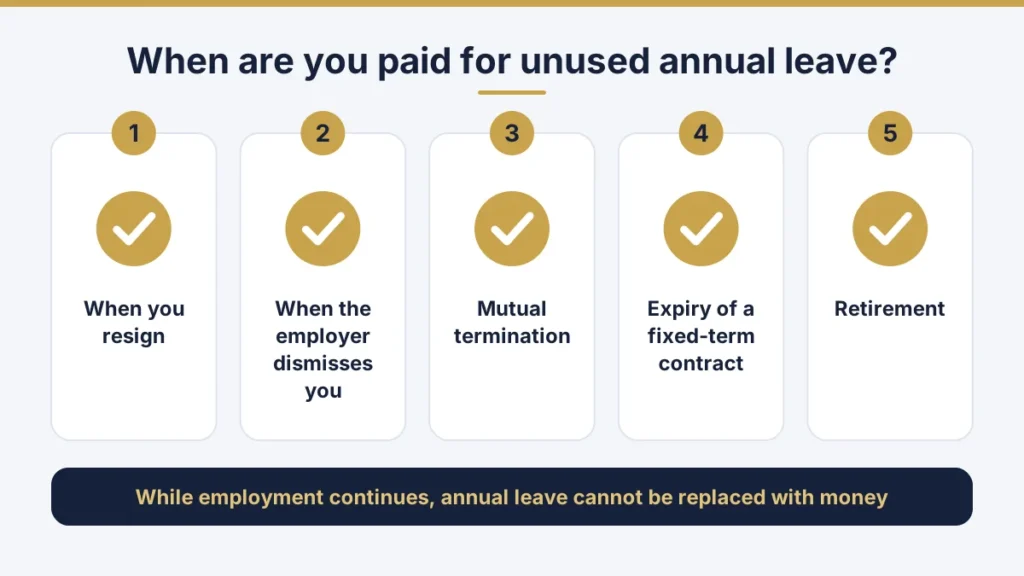
The right to compensation for unused annual leave exists only when the employee’s employment relationship ends, and he has not previously used the annual leave to which he was entitled.
In other words, while the employment relationship lasts, the employee cannot demand that his annual leave be “paid”. The employer is obliged to enable him to use it.
Only when the employment relationship ends, the unused vacation days turn into a monetary claim that the employer must pay.
This rule applies regardless of the reason for the termination of the employment relationship, whether it is:
- dismissal of the employee;
- dismissal by the employer;
- mutual termination;
- expiration of a fixed-term employment contract;
- retirement.
3. Can the employer pay annual leave instead of using it?
No.
While the employment relationship lasts, annual leave cannot be replaced by monetary compensation.
In practice, it sometimes happens that an employee says:
“I don’t want to take my vacation, just pay me.”
Such an arrangement is not in accordance with the purpose of the right to annual leave. The idea of this right is that the employee gets time for rest and recovery, not additional earnings.
Therefore, the employer should not offer payment in lieu of taking annual leave, nor can the employee request such payment while the employment relationship lasts.
The only exception is when the employment relationship ends, because then it is no longer possible to use annual leave.
4. What happens to annual leave when an employee quits or ends his employment?
When an employee resigns or his employment ends for any other reason, the question arises as to what will happen to the remaining vacation days.
In practice, there are two possibilities.
The first is that the employee, if there are conditions for it, use annual leave before the day of termination of the employment relationship.
Another possibility is that it is not possible due to the organization of the work or the short time until the termination of the employment relationship. In that case, the employer is obliged to pay compensation for unused days.
It is important to emphasize that the employee does not lose this right just because he quit his job. It is a common misconception that the right to compensation exists only when the employer cancels the employment contract. That is not true.
The right to compensation exists every time the employment relationship ends, and annual leave has not been used.
5. How is compensation for unused annual leave calculated?
The amount of compensation depends on the employee’s earnings and the number of unused vacation days.
Simply put, the greater the number of unused days and the higher the average salary of the employee, the higher the compensation will be.
Example 1
Marko worked in a company for four years and quit at the end of September.
Until the day of termination of employment, he still has eight days of unused annual leave.
Since it is no longer possible to use them, the employer is obliged to pay him the appropriate monetary compensation for those eight days together with other claims upon termination of the employment relationship.
Example 2
Jelena works part-time. Her contract expires on December 31.
Due to the increased workload, she did not use five days of annual leave.
Although her contract simply expires, the employer is still obliged to pay her compensation for the five unused vacation days.
6. The most common mistakes of employees and employers
In practice, the same mistakes are often repeated, which later lead to misunderstandings or court cases.
Employee mistakes
- they believe that they can at any time request the payment of annual leave instead of using it;
- they believe that they lose their right to compensation if they resign themselves;
- they do not check how many vacation days they have left until the termination of employment.
Mistakes by employers
- does not enable the employee to use annual leave on time;
- they do not calculate compensation for unused days upon termination of employment;
- they believe that the employee has no right to compensation if he himself canceled the employment contract;
- incorrectly calculate the number of days or the amount of the fee.
Proper planning of vacations and timely resolution of all outstanding issues significantly reduce the risk of disputes between the employee and the employer.
7. FAQ – Frequently asked questions
Can an employee claim vacation pay instead of using it?
No. While the employment relationship lasts, annual leave is used through absence from work, not through payment of money.
When does an employee become entitled to compensation for unused annual leave?
When his employment relationship ends and he has not used the annual leave to which he was entitled.
Does the employee have the right to compensation if he quits on his own?
Yes. The reason for the termination of employment is not decisive. If there are unused vacation days, the employee is entitled to the appropriate compensation.
Does the employee have the right to compensation if his fixed-term contract expires?
Yes. If by the end of the contract he has not used the annual vacation, the employer is obliged to pay compensation for unused days.
Can an employer simply say that annual leave is wasted?
No. If the employment relationship ends, and the annual leave is not used, the right of the employee does not end, but is realized through monetary compensation.
When is the best time to check the status of annual leave?
Before making a decision on the termination of the employment relationship, so that the employee and the employer can determine in time whether the annual vacation will be used or whether there will be an obligation to pay compensation.
8. Conclusion
The right to annual leave is one of the most important rights in the employment relationship and aims to enable the employee to rest, recover and preserve working ability. That is why, as a rule, annual leave is used through absence from work, and not through the payment of monetary compensation.
However, when the employment relationship ends before the employee takes annual leave, the law protects his right by providing for the employer’s obligation to pay compensation for all unused days to which the employee was entitled.
Precisely because of this, both employees and employers should keep records of used vacation days in a timely manner and check whether there are outstanding obligations before the termination of the employment relationship. In this way, unnecessary misunderstandings, additional costs and possible court disputes can be avoided.
If you have a dilemma regarding the right to annual leave, compensation calculation or other employment law issues, timely legal advice can help you protect your rights and avoid unnecessary risks.
Note: This blog is for informational purposes only and does not constitute legal advice. For specific questions and legal support, please contact the Dvornić law office.