📚 Article contents
- Introduction
- What is a permanent employment contract?
- Why do employers often offer a fixed-term contract first?
- Benefits of a permanent employment contract for the employee
- The employment contract as the only basis for establishing employment
- What is needed to establish an employment relationship?
- Registering the employee with CROSO – a common mistake in practice
- How many copies of the employment contract are signed?
- What must a permanent employment contract contain?
- Signing date and start date – an important difference
- A practical example from labor law practice
- The most common mistakes made by employers and employees
- FAQ – Most common questions about permanent employment contracts
- Conclusion
1. Introduction
In this article, we explain what a permanent employment contract is, why it is the rule under the Labor Law, what its benefits are for the employee and the employer, how it is properly concluded, which mistakes are most often made in practice and how costly they can be. The article is intended for both employees and employers who want security, legality and a long-term employment relationship.
2. What is a permanent employment contract?
A permanent (open-ended) employment contract is the basic and most stable form of establishing employment in the Republic of Serbia. As the name suggests, this contract has no predetermined duration; it lasts until one of the statutory grounds for termination of employment occurs.
Under the Labor Law, a permanent employment contract is the rule, while a fixed-term employment contract is the exception. Nevertheless, in practice employers often first hire an employee on a fixed-term basis and only later, after assessing their abilities, offer a permanent contract.
3. Why do employers often offer a fixed-term contract first?
In a real business environment, employers want a certain degree of security before making a long-term commitment to a new employee. That is why a fixed-term contract is often used as:
- a “probationary period” in practice
- a way to assess the employee’s qualifications and work habits
- a test of how well they fit into the team and the organization
Once the employer is satisfied that the employee meets expectations, this is usually followed by the conclusion of a permanent employment contract, which stabilizes and formally consolidates the employment relationship.
4. Benefits of a permanent employment contract for the employee
A permanent contract brings the employee a number of concrete and practical benefits:
Job security
Unlike a fixed-term contract, which ends simply when the term expires, a permanent contract cannot end “automatically”. Its termination requires a legal ground (dismissal, agreement, retirement, etc.).
Better chances of getting a loan
Banks and leasing companies look much more favorably on employees with a permanent contract. Whether it is:
- a consumer loan
- a mortgage
- a car loan or leasing
a permanent contract dramatically increases the chances of approval.
Long-term professional stability
An employee with a permanent contract has a better negotiating position, finds it easier to plan for the future and feels a stronger sense of belonging to the company.
5. The employment contract as the only basis for employment
It is important to emphasize that employment can be established exclusively by an employment contract.
All other contracts, such as:
- a service contract
- a contract for temporary and occasional work
- a copyright contract
do not constitute employment, but work outside an employment relationship.
This means that:
- the worker does not have the same rights as an employee with an employment contract
- there is no full labor law protection
- abuses are common
This rule applies to both Serbian and foreign nationals working for an employer registered with the Serbian Business Registers Agency (APR).
6. What is needed to establish an employment relationship?
Signing an employment contract is a key step, but not the only one.
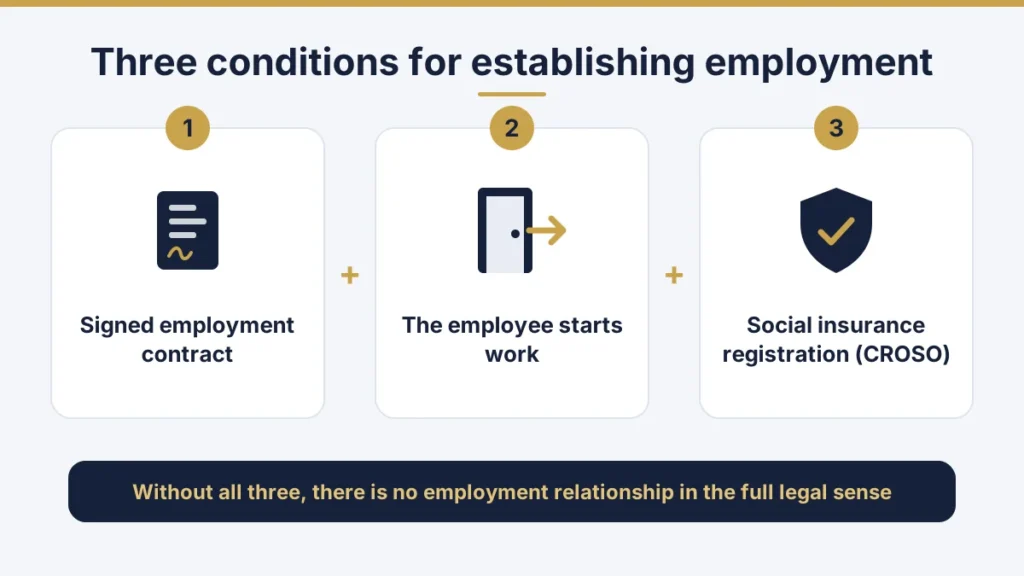
The Labor Law provides that three conditions are necessary to establish employment:
- A concluded employment contract
- The employee starting work
- Registration for compulsory social insurance (CROSO)
Unless all three conditions are met, the employment relationship does not exist in the full legal sense.
7. Registering the employee with CROSO – a common mistake in practice
After signing a permanent employment contract, the employer is obliged to register the employee for compulsory social insurance no later than before they start work, i.e. within three days from the day they begin performing the work.
In practice, it often happens:
- that the employee starts working “on a handshake”
- that the registration is late
- that it is considered “not urgent”
This constitutes a misdemeanor and can lead to serious fines for the employer.
8. How many copies of the employment contract are signed?
The employment contract is concluded in at least three copies:
- two copies are kept by the employee
- one copy is kept by the employer
This is also important from an evidentiary perspective, especially in the event of a dispute.
9. What must a permanent employment contract contain?
The employment contract regulates the mutual rights and obligations of the employee and the employer, and its mandatory elements are:
- job title and description
- place of work
- level of qualifications
- contract duration (permanent)
- start date
- working hours
- salary amount (net and gross)
- duration of annual leave
- other rights and obligations
A well-drafted contract prevents misunderstandings and potential disputes.
10. Signing date vs. start date
An employee may sign the employment contract on one date, while the start date may be set later.
However, the law provides for an important consequence:
If the employee signs the contract but does not show up for work on the start date, the employment is deemed not to have been established, unless there is a justified reason for the absence (illness, force majeure, etc.).
11. A practical example from practice
Example:
An employee signs a permanent employment contract on 1 March, with a start date of 15 March. If they do not show up for work on 15 March and do not justify their absence, the employer has grounds to consider that the employment never began.
12. The most common mistakes made by employers and employees
- working without CROSO registration
- misuse of service contracts
- vaguely defined job description
- no written contract
- signing a “blank” contract
All these mistakes can lead to serious legal consequences in terms of misdemeanor proceedings against employers and labor disputes.
13. FAQ – Most common questions about permanent contracts
Can a permanent contract end easily?
No. A legal ground and the prescribed procedure are required to terminate employment.
Can a foreigner have a permanent contract in Serbia?
Yes, provided that the foreigner has a previously approved single permit.
Is a permanent contract mandatory?
No, but it is the statutory rule and the recommended form of employment.
Must an employment contract be in writing?
Yes. A verbal contract has no legal effect.
14. Conclusion
A permanent employment contract is the foundation of a stable and lawful employment relationship. It protects both the employee and the employer, provides security, clearly defines rights and obligations and reduces the risk of disputes.
Whether you are an employee who wants security or an employer who wants to do business lawfully, a proper employment contract is an investment, not a cost.
For any additional information and legal support, the Dvornić law office is at your disposal.
Note: This blog is for informational purposes only and does not constitute legal advice. For specific questions and legal support, please contact the Dvornić law office.