Content
- What is wrongful termination?
- When can an employer legally cancel an employment contract?
- When can a dismissal be considered illegal?
- Is it a sufficient reason for dismissal or must the procedure also be followed?
- What is the deadline for filing a lawsuit for wrongful dismissal?
- What can the employee demand in court?
- What can an illegal dismissal mean for an employer?
- Practical examples
- FAQ – most frequently asked questions
- Conclusion
Termination of employment represents one of the most sensitive situations between an employee and an employer. The Labor Law stipulates that the employer has the right to terminate an employee’s employment contract when there is a legal reason for doing so, but the existence of a reason in itself is not always sufficient. Termination must also be carried out through the appropriate procedure.
This is precisely why the question arises in practice: when is dismissal illegal and what can an employee do if he believes that his employment has ended against the law?
It is important to react quickly. The deadline for initiating a legal dispute due to the violation of rights from the employment relationship is 60 days from the delivery of the decision, that is, from the knowledge of the violation of rights.
1. What is illegal dismissal?
In the simplest terms, illegal dismissal exists when the employee’s employment relationship is terminated without a proper legal basis or when the employer does not carry out the procedure prescribed by law during the dismissal.
Therefore, the legality of dismissal should be viewed from two angles.
The first question is whether there was a valid reason for the dismissal.
Another question is whether the employer has implemented the prescribed procedure.
In practice, it happens that the employer has a justified reason for terminating the employment relationship, but makes serious procedural mistakes. The reverse also happens – the procedure formally looks correct, but the facts stated as the reason for the dismissal do not justify the termination of the employment relationship.
Therefore, the legality of the dismissal cannot be assessed only on the basis of the name or one sentence from the decision on dismissal.
2. When can the employer legally cancel the employment contract?
The law provides for various reasons for which the employer can cancel the employment contract.
In simple terms, they can refer to the employee’s abilities and results, violation of work obligations, non-compliance with work discipline, or the needs of the employer, such as technological, economic or organizational changes due to which the need for certain jobs ceases or the volume of work is reduced.
However, it is not enough to simply write that the employee “violated work discipline”, “worked poorly” or became “technologically redundant”.
The reason for dismissal must correspond to the actual factual situation, and the employer must be able to explain and substantiate the reasons for the termination of the employment relationship.
3. When can a dismissal be considered illegal?
There are a number of situations in which the legality of a dismissal may be disputed.
One of the most common is the case when there is no real reason for dismissal.
For example, an employee is formally declared redundant, but shortly after his departure, another person is hired for the same job. This is precisely why the law limits the employment of another person in the same job for a period of three months, with certain legal exceptions, in the case of a certain dismissal due to the termination of the employee’s need for work.
A problem can also exist when an employee is fired due to a breach of duty that is not sufficiently specific or for which there is no adequate evidence.
The law also provides for circumstances that are not in themselves considered a justified reason for dismissal, including, among others, temporary inability to work due to illness, exercise of certain rights related to parenthood, membership in a trade union, certain personal characteristics of an employee and addressing the competent authorities for the protection of rights from the employment relationship.
4. Is there a sufficient reason for dismissal or must the procedure also be followed?
This is one of the most important questions for employers.
The existence of a reason for termination does not automatically mean that the termination is legal.
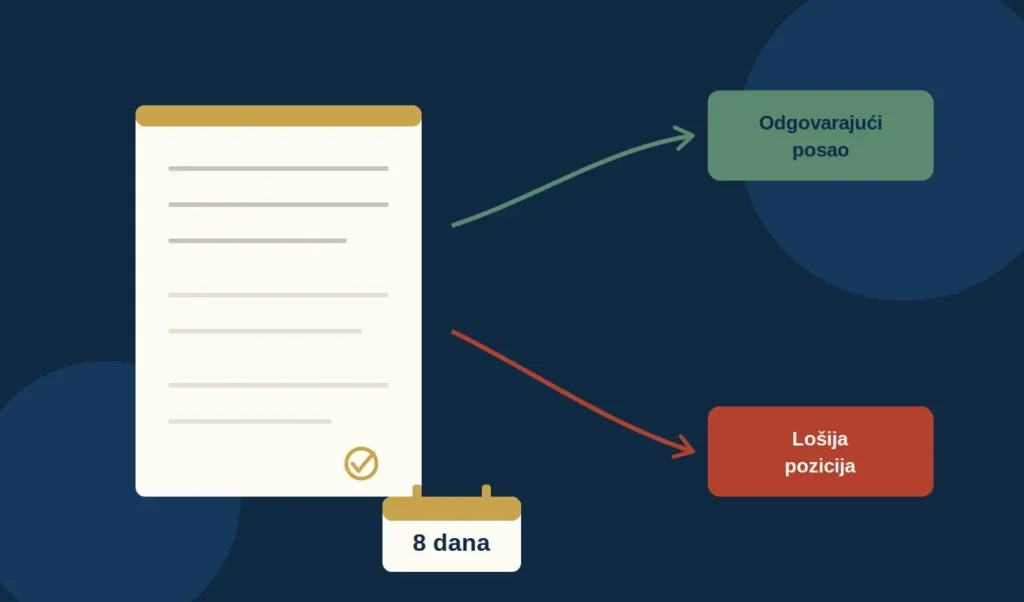
In the case of dismissal due to violation of work obligations or non-compliance with work discipline, the employer, before making a decision on dismissal, is obliged to warn the employee in writing of the existence of the reason for dismissal and give him at least eight days to explain.
The warning should contain the grounds for the dismissal, the facts and evidence on which the employer bases its allegations and the deadline in which the employee can provide an answer.
In case of dismissal due to deficiencies in work, i.e. failure to achieve the required results or lack of necessary knowledge and abilities, the law also provides for prior written notice of deficiencies, instructions to the employee and an appropriate deadline to improve the work.
The decision on dismissal itself must be in writing and contain an explanation and instruction on the legal remedy, and the law also regulates the manner in which it is delivered to the employee.
That is why procedural errors should not be seen as unimportant administration. They can have serious legal consequences.
5. Time limit for filing a claim for illegal dismissal – 60 days
For an employee who believes they have been wrongfully dismissed, this is probably the most important piece of information in the entire text.
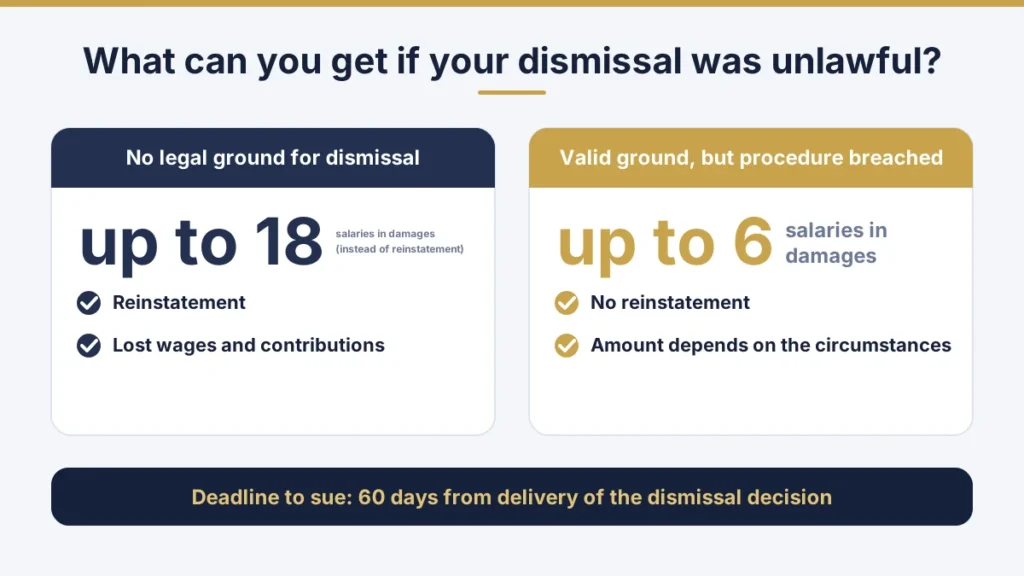
The deadline for initiating a court dispute is 60 days from the day of delivery of the decision by which the employee’s right was violated, that is, from the day the employee became aware of the violation of his right.
Therefore, the employee should not wait several months to decide what to do.
A practical example
On September 1, the employee received a decision on dismissal and he believes that the reason stated in the decision is not true.
It is not good to start from the assumption that he has three years to challenge the dismissal just because certain monetary claims from the employment relationship expire within three years. A special period of 60 days is relevant for initiating a dispute challenging a violation of rights. The law, separately, provides for a three-year statute of limitations for monetary claims from the employment relationship.
6. What can the employee demand if the dismissal is illegal?
The consequences of illegal dismissal depend on the circumstances of the case and what the employee demands.
If the court determines that the employee’s employment has been terminated without a legal basis, the employee may request reinstatement, compensation for lost wages and payment of the corresponding contributions for the period in which he did not work.
An employee, however, does not necessarily want to return to an employer with whom there has already been a serious conflict.
If he does not demand reinstatement, the court, under legal conditions, can award him compensation in the amount of a maximum of 18 wages, taking into account the time spent with the employer, the years of the employee’s life and the number of dependent family members.
It is especially important to distinguish the situation in which there was no legal basis for the termination of the employment relationship at all from the situation in which the basis existed, but the employer made a mistake in the procedure. If the court determines that there was a reason for the termination of the employment relationship, but that the legal procedure was not carried out, it can refuse to return the employee to work and award damages of up to six wages.
7. What can illegal dismissal mean for an employer?
For the employer, illegal dismissal is not just a matter of canceling a decision.
Depending on the case, the consequences may include reinstatement of the employee, the obligation to pay lost wages, the payment of contributions, compensation for damages and court costs.
Therefore, it is legally safer for the employer to check not only whether there is a reason for dismissal, but also whether he can prove that reason and whether a procedure has been implemented that corresponds to that very reason for termination of employment.
The most expensive dismissals are often not those in which the employer had no reason, but those in which there was a problem with the employee, but the decision was made too quickly and without a properly implemented procedure.
8. Practical examples of illegal dismissal
Example 1 – Cancellation without prior warning
The employer believes that the employee continuously violates work discipline and immediately hands him a decision on dismissal.
If in the specific case the law required a prior written warning and the opportunity for the employee to express himself, skipping that procedure can be a significant problem for the employer.
Example 2 – “Poor work” with no opportunity to improve the work
The employee’s contract is canceled because he allegedly does not achieve the required results, but the shortcomings were not clearly stated to him beforehand, nor was he given instructions and an appropriate deadline for improving his work.
And such dismissal can be disputed precisely because of the way in which the procedure was carried out.
Example 3 – The employee does not want to return to work
After the illegal dismissal, the employee finds another job and no longer wants to work for the former employer.
This does not automatically mean that he is not entitled to protection. The law allows that, instead of returning to work, under certain conditions, he can request an appropriate monetary compensation.
FAQ – the most frequently asked questions about illegal dismissal
What is the deadline for filing a claim for wrongful dismissal?
The deadline is 60 days from the delivery of the decision, i.e. from the knowledge of the violation of rights.
Does every procedural failure mean reinstatement of the employee?
No. If there was a justified reason for the termination of the employment relationship, but the employer made a mistake in the procedure, the law foresees the possibility of awarding compensation of up to six wages without returning the employee to work.
Does the employee have to go back to work if they win a dispute?
No. The employee may not request reinstatement and may, under legal conditions, request compensation for damages.
Can sick leave be a reason for dismissal?
The mere temporary inability to work due to illness, accident at work or occupational disease does not constitute a justified reason for dismissal.
Does the employer have to explain the dismissal?
Yes. The decision on dismissal must be in writing and must contain an explanation and an instruction on the legal remedy.
What should an employee do first when he gets fired?
The most important thing is to save the solution and determine the date when it was delivered. After that, you should check the reason stated in the decision, the previous documentation, any warning and the course of the procedure, bearing in mind that the deadline for initiating a dispute is only 60 days.
10. Conclusion
Termination of the employment contract is not illegal just because the employee does not agree with it, nor is it legal just because the employer stated a certain reason in the decision. For the legal termination of the employment relationship, it is necessary that there is an appropriate legal basis, that the facts on which the dismissal is based can be substantiated, and that the procedure required by law be implemented.
It is especially important for the employee to react in a timely manner, because the deadline for contesting a violation of rights is short. For the employer, on the other hand, it is much safer to check the entire procedure before making a decision than to try to eliminate its shortcomings only when a labor dispute arises.
Therefore, a properly implemented termination procedure is not just a formality. It protects the rights of the employee, but at the same time provides legal certainty to the employer and significantly reduces the risk that the termination of the employment relationship turns into a long-term and expensive dispute.
Note: This blog is for informational purposes only and does not constitute legal advice. For specific questions and legal support, please contact the Dvornić law office.