📚 Article contents
- Introduction
- What is a fixed-term employment contract?
- When may an employer conclude a fixed-term contract?
- How long can a fixed-term employment contract last?
- When does a fixed-term contract turn into a permanent contract?
- Rights of an employee working on a fixed-term basis
- CROSO registration and starting work – the employer’s legal obligations
- A practical example from labor law practice
- The most common employer mistakes with fixed-term contracts
- Fixed-term contract and probationary period – important differences
- FAQ – Most common questions about fixed-term employment contracts
- Conclusion
In this article, we explain what a fixed-term employment contract is, when an employer can lawfully conclude it, how long it can last, what the employee’s rights are, what the most common abuses in practice are and when a fixed-term contract “turns into” a permanent one. The article is intended for both employees and employers who want a lawful and secure employment relationship.
1. Introduction
A fixed-term employment contract is one of the most common forms of employment in practice, but at the same time one of the most frequently misused institutions of labor law. Although employers often see it as a “flexible solution”, the Labor Law treats it as an exception, not the rule.
Improperly concluding a fixed-term contract can lead to serious consequences – from inspection fines and court disputes to the employment automatically turning into a permanent contract.
Below, we explain all the key aspects of fixed-term employment contracts – clearly, practically and in plain language.
2. What is a fixed-term employment contract?
A fixed-term employment contract is a contract establishing employment for a predefined period of time or until a certain event occurs.
Unlike a permanent contract, with this contract:
- it is known in advance when it ends,
- it ends upon expiry of the term, without a separate dismissal decision,
- it is used only in situations permitted by law.
Important: The Labor Law clearly provides that a fixed-term contract is the exception, while a permanent contract is the rule.
3. When may an employer conclude a fixed-term contract?
An employer may lawfully conclude a fixed-term employment contract only if there is an objective and justified reason, such as:
- a temporarily increased workload
- work on a project with a predetermined duration
- replacing an absent employee (sick leave, maternity leave)
- with a foreign national who has an approved single permit
- with a newly established employer in its first year after incorporation, etc.
4. How long can a fixed-term contract last?
Under the Labor Law, a fixed-term employment contract may last a maximum of 24 months, either:
- through one contract, or
- through several consecutive contracts
Breaks shorter than 30 days are also counted toward those 24 months.
Exceptions to the rule (important in practice)
In certain situations, the contract may last longer than 24 months, e.g.:
- work on a project whose duration is set in advance, at most until the project is completed, in which case it is advisable to state exactly which project is involved and how long it lasts,
- replacing a temporarily absent employee, in which case it is necessary to state exactly which employee is being replaced, but it is not necessary to state the reason for the employee’s absence,
- work with foreign nationals who have an approved single permit in accordance with the Law on Foreigners and the Law on Employment of Foreigners.
5. When can a fixed-term contract turn into a permanent contract?
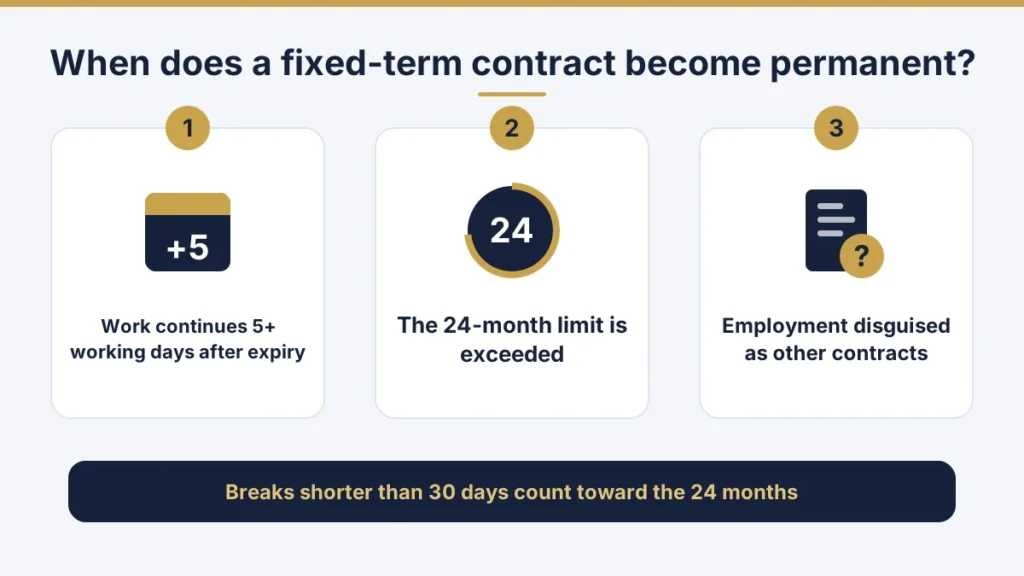
This is one of the most important questions that arise in practice.
A fixed-term employment contract automatically turns into a permanent contract if:
- the employee continues to work for at least five working days after the contract expires, and the employer does not object
- the fixed-term contract lasts longer than the period permitted by law
- the employer disguises an actual employment relationship through other contracts outside employment (a contract for temporary and occasional work, a service contract, etc.).
In these situations, the law protects the employee, regardless of what is written in the contract, and the employee may file a lawsuit to establish that the employment is permanent.
6. Rights of an employee on a fixed-term contract
A common misconception is that a fixed-term employee has “fewer rights”. That is not true.
A fixed-term employee has the same basic rights as a permanent employee, including:
- the right to a salary
- the right to annual leave
- the right to sick leave
- the right to safe working conditions
- the right to be registered for compulsory social insurance (CROSO)
The difference lies solely in the duration of employment and how it ends. In the case of fixed-term employment, the employment may simply end upon expiry of the term for which it was established, and in that case the employer only issues a decision confirming the termination of employment.
7. CROSO registration and starting work
The same rules apply to fixed-term contracts:
Lawful establishment of employment requires:
- a signed employment contract
- the employee starting work
- registration for compulsory social insurance (CROSO)
8. A practical example from practice
Example:
An employee signs a 6-month fixed-term contract due to an “increased workload”. After the contract expires, the employer does not conclude a new contract, but the employee continues to work for another two weeks.
In this case, the employment is deemed to have been established for an indefinite period, regardless of the employer’s intention.
9. The most common employer mistakes
The following mistakes are most common in practice:
- “chaining” fixed-term contracts for years
- no real reason for a fixed duration
- failure to register the employee with CROSO
- using a fixed-term contract as a substitute for a probationary period
- breaks of a few days to “reset the clock”
All these mistakes can lead to misdemeanor fines and court disputes.
10. Fixed-term contract and probationary period – not the same
It is important to distinguish between these two institutions.
- A probationary period is agreed within the employment contract and may also exist in a permanent employment contract
- may also exist in a permanent contract
- has clearly prescribed rules.
A fixed-term contract is not a substitute for a probationary period, although this is often wrongly done in practice.
11. FAQ – Most common questions about fixed-term contracts
Does the employer have to extend a fixed-term contract?
It may, if the fixed-term contract has not lasted longer than 24 months, or if it was in line with the exceptions to the 24-month limit.
Before the fixed-term contract expires, the employer may conclude an annex to the contract with the employee or, after it expires, the employer may conclude a new fixed-term contract or a permanent contract.
Is a fixed-term employee entitled to annual leave?
Yes, in proportion to the time spent at work.
Can a fixed-term contract be terminated before it expires?
Yes, but only under the conditions provided for by the Labor Law, the work regulations and the contract.
Can a fixed-term contract be extended several times?
Yes, but the total duration must not exceed the statutory maximum.
12. Conclusion
A fixed-term employment contract is not a “free choice”, but a strictly regulated institution of labor law. Its incorrect application often leads to legal problems for both employers and employees.
If used lawfully – it can be a useful tool.
If abused – it becomes a serious risk.
This is why it is always advisable to conclude a fixed-term employment contract with a clear understanding of the statutory limits and consequences.
For any additional information and legal support, the Dvornić law office is at your disposal.
Note: This blog is for informational purposes only and does not constitute legal advice. For specific questions and legal support, please contact the Dvornić law office.